
The radio interface developed by Gdańsk Tech scientists will be an innovative product in the Internet of Things device market.
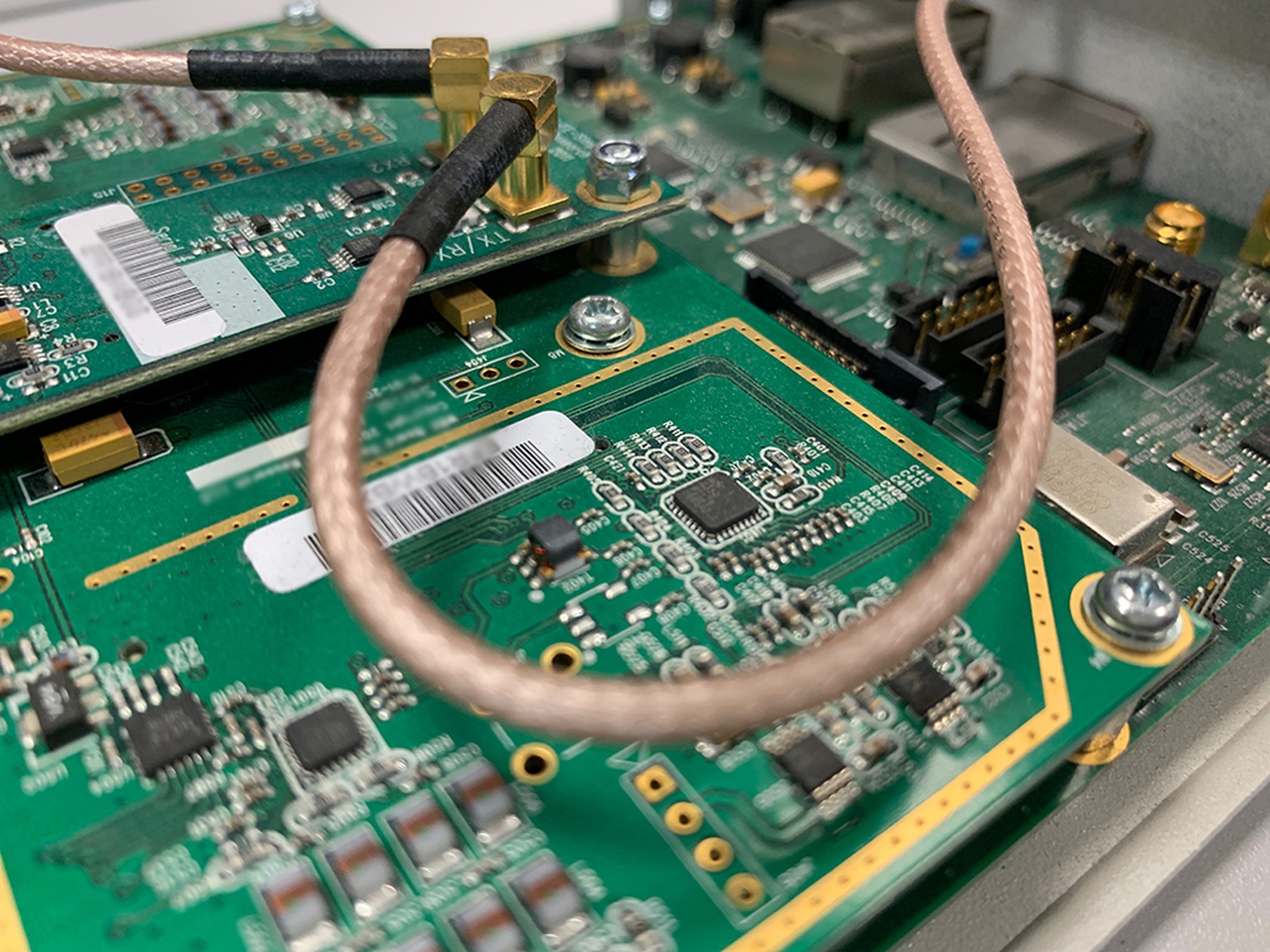
For the next three years, a team of scientists from the Department of Radiocommunication Systems and Networks at the Faculty of Electronics, Telecommunications and Informatics (WETI), led by PhD Eng. Krzysztof K. Cwalina, will carry out research aimed at developing a configurable hardware-software radio interface that will be used in smart Internet of Things devices, including in the energy, gas, and water supply sectors.
For the next three years, a team of scientists from the Department of Radiocommunication Systems and Networks at the Faculty of Electronics, Telecommunications and Informatics (WETI), led by PhD Eng. Krzysztof K. Cwalina, will carry out research aimed at developing a configurable hardware-software radio interface that will be used in smart Internet of Things devices, including in the energy, gas, and water supply sectors.
The project "Software-defined, universal radio interface for intelligent Internet of Things devices" is carried out by a consortium led by DGT sp. z o.o. The total project budget exceeds 10 million PLN, with funding obtained through a competition by the National Centre for Research and Development under the Intelligent Development Operational Programme exceeding 8 million PLN.
The radio interface, named DUCH IoT (Internet of Things), will be used to expand existing or implement new Internet of Things devices. The Internet of Things is one of the most rapidly developing technology areas and concerns devices that collect and process data as well as perform radio communication. Such devices include, among others, remote surveillance cameras, motion sensors, weather stations, electricity, gas or water meters, vehicles, or industrial machines. The number of intelligent devices that are to perform radio communication is continuously increasing. The solution proposed by scientists from Gdańsk Tech will enable radio communication between such devices in accordance with international standards, utilizing the infrastructure of fixed LTE networks, next-generation NGN (Next Generation Network) networks, particularly 5G networks.
– Our radio interface is also intended to enable information transmission within the national critical infrastructure, for example, advanced telemetry of energy and water infrastructure, advanced alarm systems, and remote surveillance – explains PhD Eng. Krzysztof Cwalina.
The project implementation is divided into three stages. The first and second parts are industrial research and development work jointly conducted by scientists from the Faculty of Electronics, Telecommunications and Informatics and employees of DGT, respectively, while the third part consists of pre-implementation works carried out exclusively by the consortium leader – DGT.
– Such an interface does not yet exist on the Polish market, and according to our information, not even on the EU market – adds PhD Eng. Krzysztof K. Cwalina – Our product, developed as a software-hardware framework, will be installed in devices intended to operate in environments with challenging radio wave propagation, e.g., basements, underground parking lots. Thanks to proprietary algorithms for adaptive radio signal reception, effective operation of the radio link between the IoT device and the cellular network operator’s base station will be possible, which will positively affect, among others, the energy efficiency of that device.
The project is co-financed by the European Union from the European Regional Development Fund under the Intelligent Development Operational Programme 2014-2020 under Sub-measure 1.1.1. The project is implemented under the competition of the National Centre for Research and Development: 6/1.1.1/2019 Fast Track.