
This is a time of intensive development for me. Aleksandra Laska, Doctoral School graduate
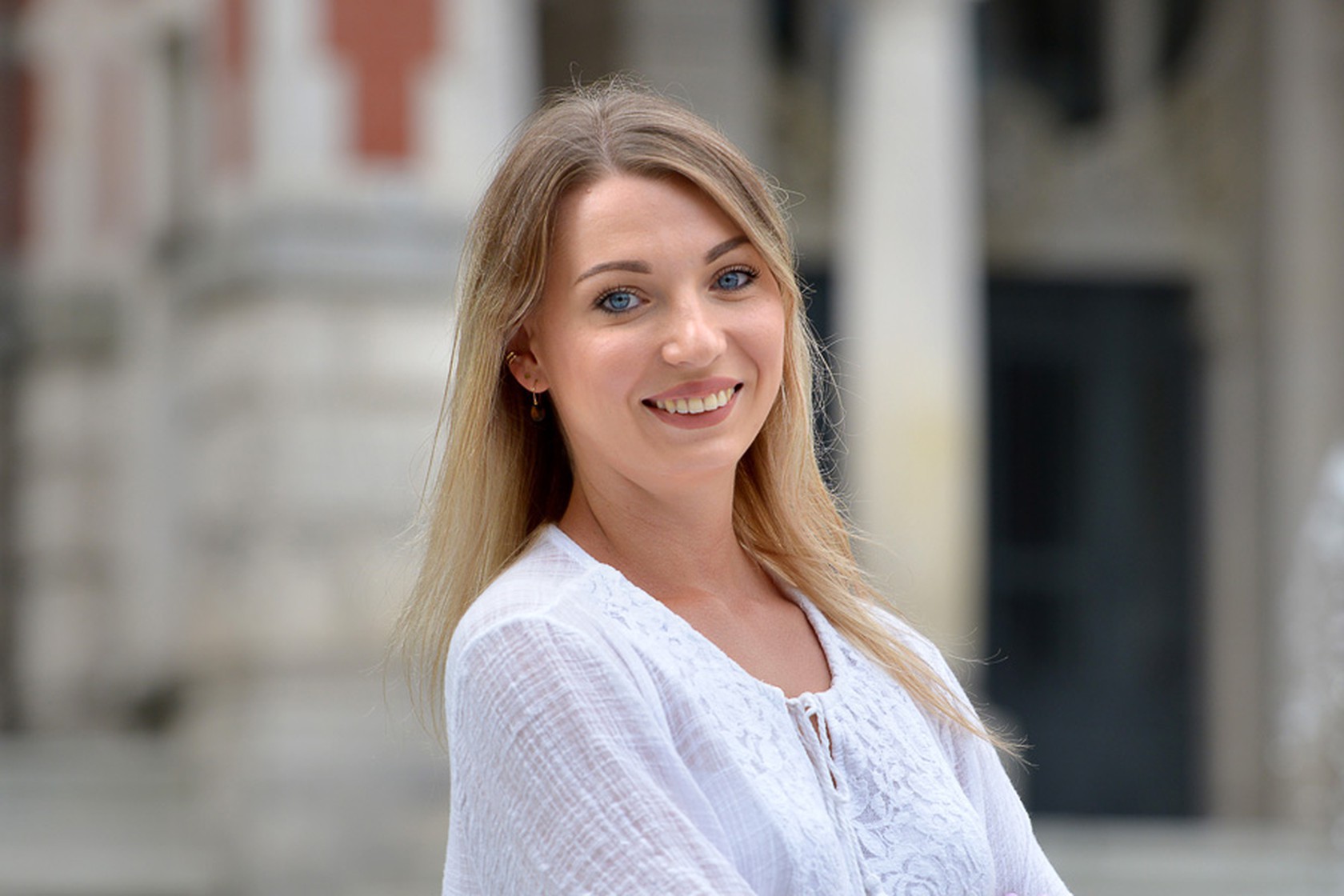
Aleksandra Laska from the Faculty of Mechanical Engineering and Ship Technology is another graduate of the Doctoral School under the new doctoral education system. Her scientific interests focus on mechanical engineering, and in her doctoral dissertation, she studied the properties of joints made from aluminum alloys.
Aleksandra Laska from the Faculty of Mechanical Engineering and Ship Technology is another graduate of the Doctoral School under the new doctoral education system. Her scientific interests focus on mechanical engineering, and in her doctoral dissertation, she studied the properties of joints made from aluminum alloys.
The doctoral thesis supervisor of the researcher, entitled „Influence of friction stir welding technological parameters on the properties of the joints of selected aluminum alloys” (Wpływ parametrów technologicznych zgrzewania tarciowego z przemieszaniem na własności złączy z wybranych stopów aluminium) is prof. Marek Szkodo. The reviewers are dr hab. inż. Mirosław Czechowski, professor at UMG (Gdynia Maritime University), prof. dr hab. inż. Lucjan Śnieżek (Military University of Technology), prof. dr hab. inż. Agata Dudek (Czestochowa University of Technology).
– My doctoral thesis concerns the influence of residual stresses and dislocation density on the mechanical and physicochemical properties of welds produced by a modern, innovative technology called Friction Stir Welding – explains Aleksandra Laska.
Friction Stir Welding is a solid-state friction welding method, in which, using a special rotating tool, it is possible to obtain joints with high mechanical properties, free from cracks and porosity. The process can be carried out on milling machines, specialized friction welding machines, and robotic workstations.
– In this method, the welding process consists of mechanical mixing of materials. In the case of my research, these are aluminum alloys in a softened state. Through this mechanical mixing, residual stresses appear in the material. They occur very frequently and are often the cause of problems, especially in traditional welding processes. They can lead, for example, to material cracking. In my work, I analyzed process parameters, including rotational speed, linear speed, and tool geometry, as well as their influence on the mechanical and electrochemical properties of the material.
When aluminum alloys are subjected to welding, defects easily form. Additionally, during the solidification of the melted material caused by the supplied energy, hydrogen is released in the form of gas bubbles, which can be trapped in the cooling metal, causing porosity. Using the FSW method, i.e., friction stir welding, significantly reduces these risks.
– In my research, I focus on aluminum alloys because this is a material that, along with other composites, is slowly displacing steel in the industrial market. Steel is a heavy material, and in shipbuilding and especially in aviation, weight plays an important role – emphasizes Aleksandra Laska.
In the near future, the researcher plans to continue the studies started in her doctoral dissertation. From October, she will begin full-time work at WIMiO in the Department of Machine Technology and Production Automation.
– The doctoral studies period was very fruitful for me – says the doctoral candidate – Apart from the studies themselves, I was also employed in the Faculty as a technical staff member. Thanks to this, I learned how to operate machines, and in my research I am completely independent, as the machine laboratory holds no secrets for me. Doctoral studies are also a great opportunity for international trips and networking. Unfortunately, I studied during the pandemic and limited mobility period, but despite that, I managed to undertake internships in Italy, Slovakia, and Germany, and participate in conferences in Bulgaria and Portugal.