
Acoustic Underwater Communication in the Scientific Work of a Doctoral School Graduate
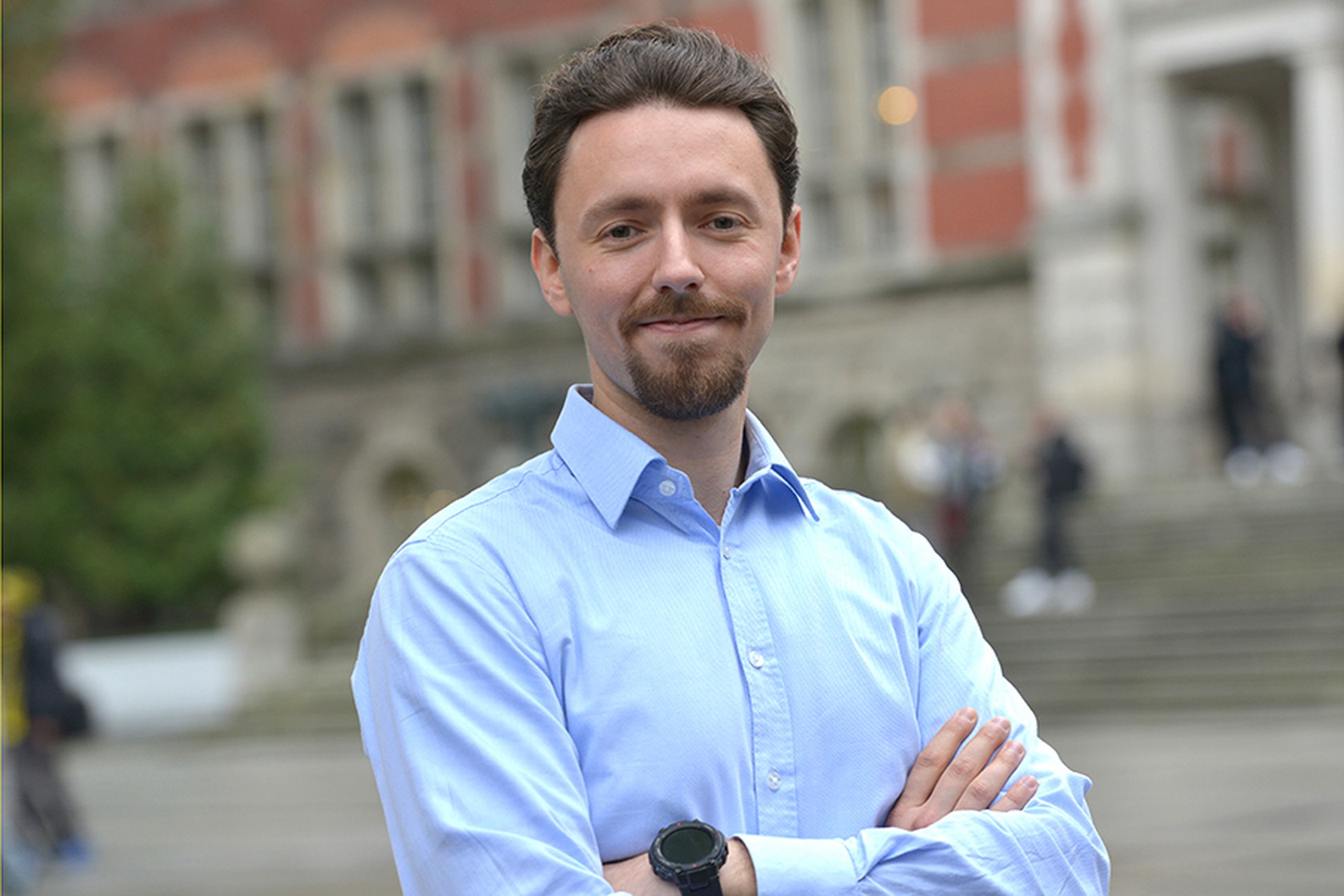
Artur Gańcza from the Faculty of Electronics, Telecommunications and Informatics is a graduate of the Doctoral School. His scientific activity focuses on system identification with particular emphasis on models in underwater communication.
Artur Gańcza from the Faculty of Electronics, Telecommunications and Informatics is a graduate of the Doctoral School. His scientific activity focuses on system identification with particular emphasis on models in underwater communication.
The doctoral dissertation "Local Basis Function Method in the Identification of Non-Stationary Processes" was written under the supervision of Prof. Maciej Niedźwiecki from the Department of Signals and Systems at WETI. Process identification is a field focused on creating mathematical models of phenomena (objects or signals) based on experimental data. The doctoral candidate's research concentrates on building models in underwater acoustic communication.
– Imagine a situation where there are two underwater objects mutually sending acoustic signals to each other. The problem arises when simultaneously sending and receiving a signal from the other object. What arrives to me will be contaminated by the signal I am sending and will include reflections of that signal, for example, from the water surface or from various underwater objects moving in that area. In my research, I focus on removing such disturbances from the received signal by modeling the underwater channel as a system with time-varying parameters – explains the scientist. – The methods I propose in my research on this problem are a computationally inexpensive variant of the most effective methods in this field. Moreover, in underwater communication, the model parameters typically behave very differently. Each is related to the reflection of sound from a different element. As a result, some parameters of such a model are constant, some change faster, others slower, and still others are simply zero. Another novelty of the method I am working on is the ability to analyze each model parameter separately.
The doctoral dissertation continues research already conducted during the master's studies. The doctoral candidate is currently a full-time employee of Gdańsk Tech. He plans to defend his doctoral thesis at the beginning of 2024.
– Scientific work requires a specific approach: asking questions, probing, not being satisfied with simple solutions. One must be inquisitive and patient. I believe I possess these qualities, and for me, choosing the Doctoral School was a very good decision, despite the temptations offered by the commercial market, especially for graduates of my faculty. But it was a conscious and well-thought-out decision. I have been and still am fortunate to work with Prof. Maciej Niedźwiecki, a world-class scientist who wants and is able to share knowledge. Finding such a mentor is the most valuable part of my doctoral studies.
Besides scientific work, Artur Gańcza is also thriving in teaching.
– Sharing knowledge and experiences is a very important aspect of my work. I really love teaching, inspiring, showing how to learn better and more effectively, what to pay attention to when assimilating particular material. I am glad I can be not only a scientist but also a lecturer.
In the near future, the scientist intends to focus on a group of Volterra models and analyze methods less sensitive to impulsive disturbances in signals.