
Design, build, test. KSTO KORAB returns from competitions in Hungary
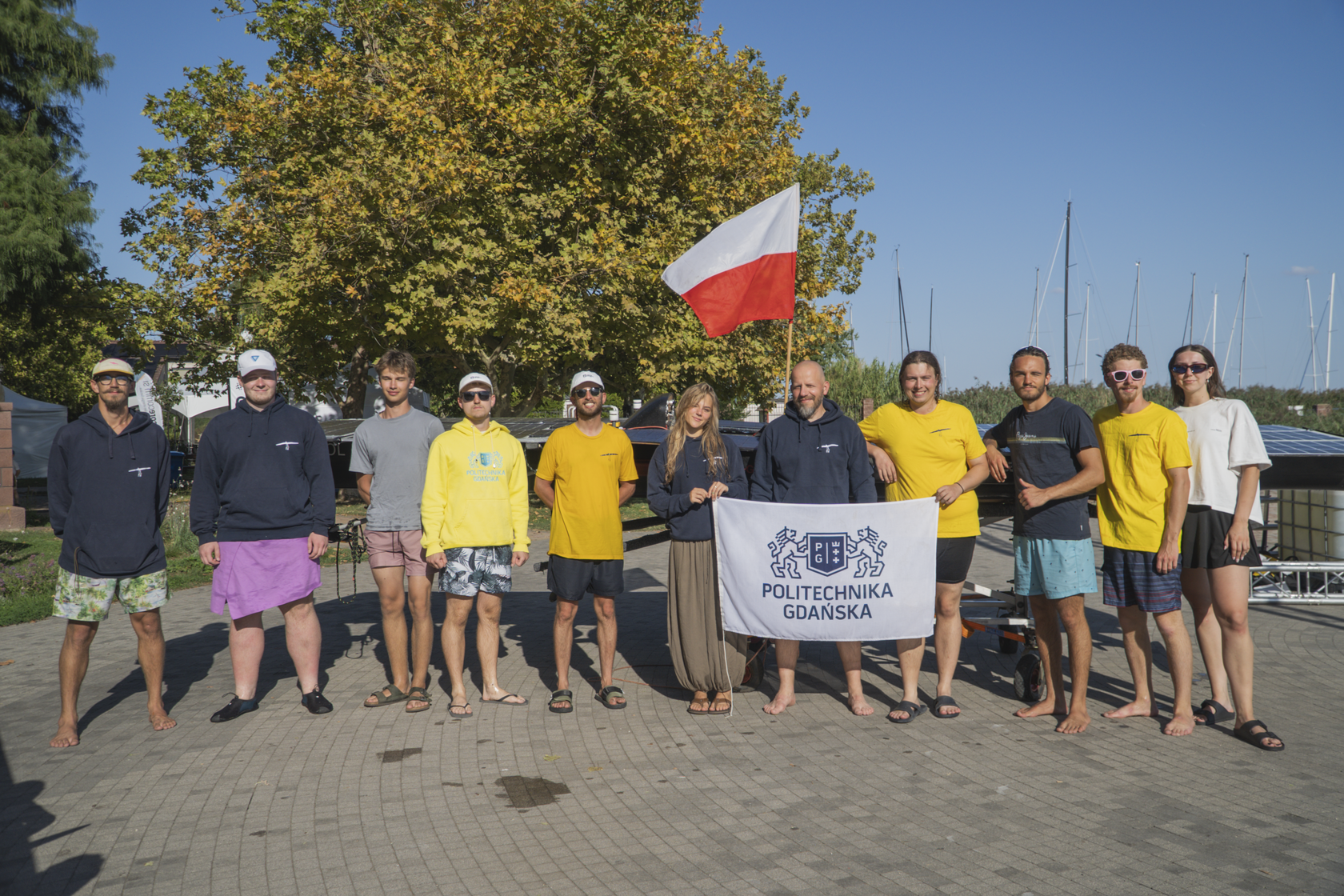
Proven solutions, an extensive data set, and a clearly defined direction for the further development of the POL32 solar boat. With this experience, the students of the Ship Technology Club KORAB returned from the CoreComm Solar Boat Challenge 2026 in Hungary. The team finished 7th overall and 3rd among technical university teams.
Proven solutions, an extensive data set, and a clearly defined direction for the further development of the POL32 solar boat. With this experience, the students of the Ship Technology Club KORAB returned from the CoreComm Solar Boat Challenge 2026 in Hungary. The team finished 7th overall and 3rd among technical university teams.
The international solar boat competition took place from August 27 to 30 in Balatonalmádi. Ten teams from the Netherlands, Hungary, Greece, and Poland participated, including five teams that presented designs operating on hydrofoils.
For KSTO KORAB, the competition is primarily a stage in the educational process. Students design mechanical, electrical, and automatic systems, build and integrate them, and then test them in direct comparison with solutions from other teams.
– We are not going solely for first place. The result provides an objective benchmark, but what matters more is what we bring back. A student can design a subsystem, build it, test it in a real race, see what needs improvement, and analyze the collected data. It's hard to get a more complete engineering experience – says Julian Serkieza from KSTO KORAB.
Prototype tested in practice
After the July competition in Kraków, POL32 received a new battery capable of delivering significantly greater peak power, a more reliable motor controller, and modified flight control elements. The telemetry system was also expanded to record, among other things, speed, propulsion power, charge status, and energy consumption.
The first day was dedicated to technical inspection and battery testing. On subsequent days, work did not end with the last race – in the evenings, students analyzed observations from the water, carried out minor repairs and adjustments. Previous testing, however, allowed them to arrive with a functioning base and focus on developing the design rather than struggling with a major failure.
Challenging start and conscious energy management
Just before the slalom start, a problem occurred with the control system. Despite limited maneuverability, the helmsman led POL32 through the hydrofoil course. The time of 1 minute and 7 seconds earned the team sixth place, and the problem was resolved later during evening work.
In the Time Trial, the low sunlight practically prevented energy replenishment from the panels. An attempt to finish at all costs would have meant almost complete battery discharge before subsequent starts, so the students consciously withdrew from the course. Seven other teams made the same decision – only two out of ten boats reached the finish line.
Almost 40 kilometers in Ton’s Race
Ton’s Race was a demonstration of strategy. Teams independently chose the order of sections between buoys, considering their length, wind, and available energy. POL32 officially covered 39.4 km and took fifth place.
According to onboard telemetry, the boat traveled 39.08 km in 2 hours and 56 minutes, achieving an average speed of 13.27 km/h. The propulsion consumed about 1.78 kWh, but thanks to the ongoing production from the panels, the net draw from the battery was approximately 0.84 kWh. The result confirmed the soundness of the decision made the previous day and allowed for testing the rebuilt systems during nearly three hours of continuous operation.
In Endurance, KSTO KORAB completed eight laps – about 40 km – in 2 hours, 40 minutes, and 2 seconds, finishing seventh. Initially, the students kept pace with the teams ahead of them. When making up the deficit began to require a disproportionate amount of energy, they conserved their reserve for the final Match Race competition.
From maximum 28 to average 35 km/h
In the Match Race, POL32 covered the entire course on hydrofoils, combining fast sections and tight turns. The average speed of one of the runs reached approximately 35 km/h. The scale of progress is best illustrated by a comparison with Sardinia in 2024: at that time, about 28 km/h was the maximum speed of a boat that could not yet effectively turn in flight.
– You really feel the power in the boat. It accelerates very well, but the biggest difference can be seen in the turns – now we can quickly and confidently navigate the entire course in flight. The helmsman has much greater control over the unit and can simply utilize the performance offered by the propulsion – says Piotr Pruszko, helmsman of POL32.
In the quarterfinal, KSTO KORAB defeated the Kraków team – AGH Solar Boat Team – with a time of 1:40 compared to the Kraków team's 1:52. A year earlier, POL32 finished this same competition about one boat length behind AGH. The victory secured the Gdańsk students a place in the semifinals among the top hydrofoils of the competition.
After losing to the eventual overall winner, the Dutch Sunflare Solarteam, POL32 was to start in the race for third place. However, the power system protection disconnected the contactor, which could not be re-engaged before the start. A quick repair restored the boat's ability to sail independently but not at full power. The team finished the Match Race in fourth place and was the best university team in this discipline.
The result is a reference point; the knowledge remains
– Working with KSTO KORAB students and jointly observing the results of our work is a great pleasure. Solving technical problems allows not only for project development but also for expanding the academic curriculum. The results achieved in successive competitions are the best proof of the effectiveness of such education. The flight control system is becoming more reliable and predictable regatta after regatta. The next goal is to catch up with the leaders in terms of photovoltaic panels used – says Dr. Eng. Wojciech Leśniewski, supervisor of KSTO KORAB.
A 12-person delegation traveled to Balatonalmádi:
● Eng. Miłosz Grunwald
● Piotr Demski
● Łukasz Gede-Niewiadomski
● Tymoteusz Maleńczyk
● Olgierd Matecki
● Patrycja Nowak
● Joanna Rakieć
● Wojciech Wierzbicki
● Julian Serkieza
● MSc Eng. Piotr Pruszko
● PhD Eng. Michał Struk
● PhD Eng. Wojciech Leśniewski
This is only a part of the people working on the project. Behind each race are months of designing, manufacturing, programming, testing, and organizing carried out by a larger group of students as well as university staff and partners supporting them.
Before the planned competition in Sardinia, POL32 will undergo minor repairs and modifications. In October, KSTO KORAB will also start recruitment – additional people will have the opportunity to follow the same path: from idea, through design and execution, to testing the solution on the water.