
Swallows of the Future 2026: Students, PhD Candidates, and Pupils Presented Projects for Safety
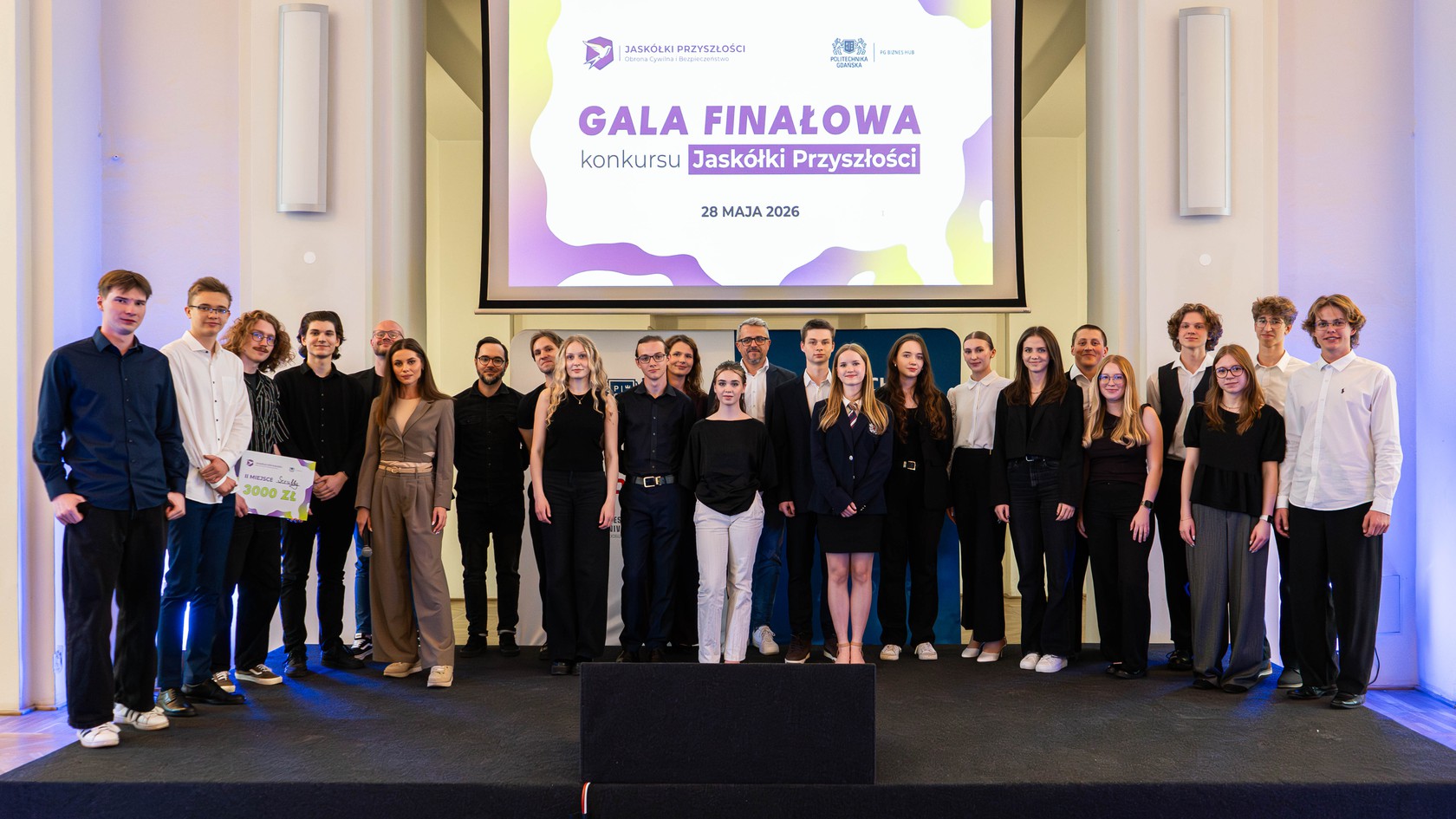
Autonomous drones for critical infrastructure monitoring, a robotic platform for ship hull inspection, and eco-friendly sorbents for industrial gas purification – these are the winning projects of this year’s edition of the Swallows of the Future competition, organized by PG Biznes Hub. The final took place on May 28, 2026, at Gdańsk Tech and was dedicated to solutions in the field of defense and broadly understood security.
Autonomous drones for critical infrastructure monitoring, a robotic platform for ship hull inspection, and eco-friendly sorbents for industrial gas purification – these are the winning projects of this year’s edition of the Swallows of the Future competition, organized by PG Biznes Hub. The final took place on May 28, 2026, at Gdańsk Tech and was dedicated to solutions in the field of defense and broadly understood security.
During the final gala, 10 teams presented their ideas. Participants showcased concepts for products, services, and technological solutions addressing challenges related to, among others, rescue operations, healthcare, infrastructure monitoring, education, environmental protection, and civil defense.
Jaskółki Przyszłości is a competition that fosters creativity, innovation, and entrepreneurship. Its goal is to support individuals who want to create innovative technological, business, and social solutions. This year’s edition was open to students and PhD candidates of Gdańsk Tech, as well as high school students from schools cooperating with the university. The final also included teams from the Communication Schools Complex named after the Defenders of the Polish Post Office in Gdańsk and the Mikołaj Kopernik High School No. I in Gdańsk.
Projects were presented in a pitching format – each team had five minutes to present their solution to the jury and the audience gathered during the event. Participants were evaluated by a jury consisting of Karolina Szlenk from OKE Poland, PhD Eng. Marcin Szczepański from the Faculty of Civil and Environmental Engineering at Gdańsk Tech, and Marcin Zieliński from PG Biznes Hub. The gala was hosted by Zuzanna Kąkol and Maciej Pawluczuk from the Innovation and Entrepreneurship Science Club GTSE operating at Gdańsk Tech.
Winners of the Jaskółki Przyszłości 2026 Competition
1st place was awarded to the project FlySwap – an autonomous drone system with intelligent docking stations enabling automatic battery swaps. The solution is designed for continuous monitoring of critical infrastructure. The project was prepared by Jakub Reszka and Ewa Bylicka.
2nd place went to Scrubby – a modular robotic platform intended for inspecting and maintaining ship hulls and marine infrastructure. The project authors are Mateusz Filipowski, Juliusz Szczepiński, and Mikołaj Zawadzki.
3rd place was awarded to Adsorba – ecological sorbents for removing volatile organic compounds from industrial gases. The materials are made from composite waste that is difficult to recycle. The project was created by Mieszko Wołyński, Julia Starukiewicz, and Magdalena Rudzińska.
The Audience Award, selected by voting during the event, was won by the project DRONECOIL, prepared by the team consisting of Szymon Filipkowski, Marek Krakowski, Gabriela Golińska, and Michał Dziedzic.