


Date added: 2026-07-20
Gdańsk Tech student creates an interactive educational model

What inspired the “The Menstrual Cycle in Action” project, and why did you decide to focus specifically on menstrual cycle education?
I wanted to combine the skills I had acquired during my studies, particularly CAD design, with my interest in feminism and women’s health. I chose the menstrual cycle as the subject of my project because there are currently no widely available teaching tools focusing on female reproductive physiology. Gynaecological health also remains a taboo subject in Poland, and this is something I would like to help change through the project.
How would you assess young people’s knowledge of menstrual cycle physiology, endometriosis and polycystic ovary syndrome?
During the “Universities of the Future” project, I participated in business mentoring, as part of which I conducted surveys among female secondary school students. I asked several very basic questions, for example about the average length of the menstrual cycle or ovulation, which I believe every woman should be able to answer. Unfortunately, only a small number of the girls answered all the questions correctly. Thanks to social media, endometriosis and polycystic ovary syndrome are becoming increasingly recognised conditions. This is a positive development, as endometriosis affects up to 10% of women, while obtaining a diagnosis takes an average of nine years.
How can the interactive model help students understand processes that are difficult to present using a traditional textbook or illustration?
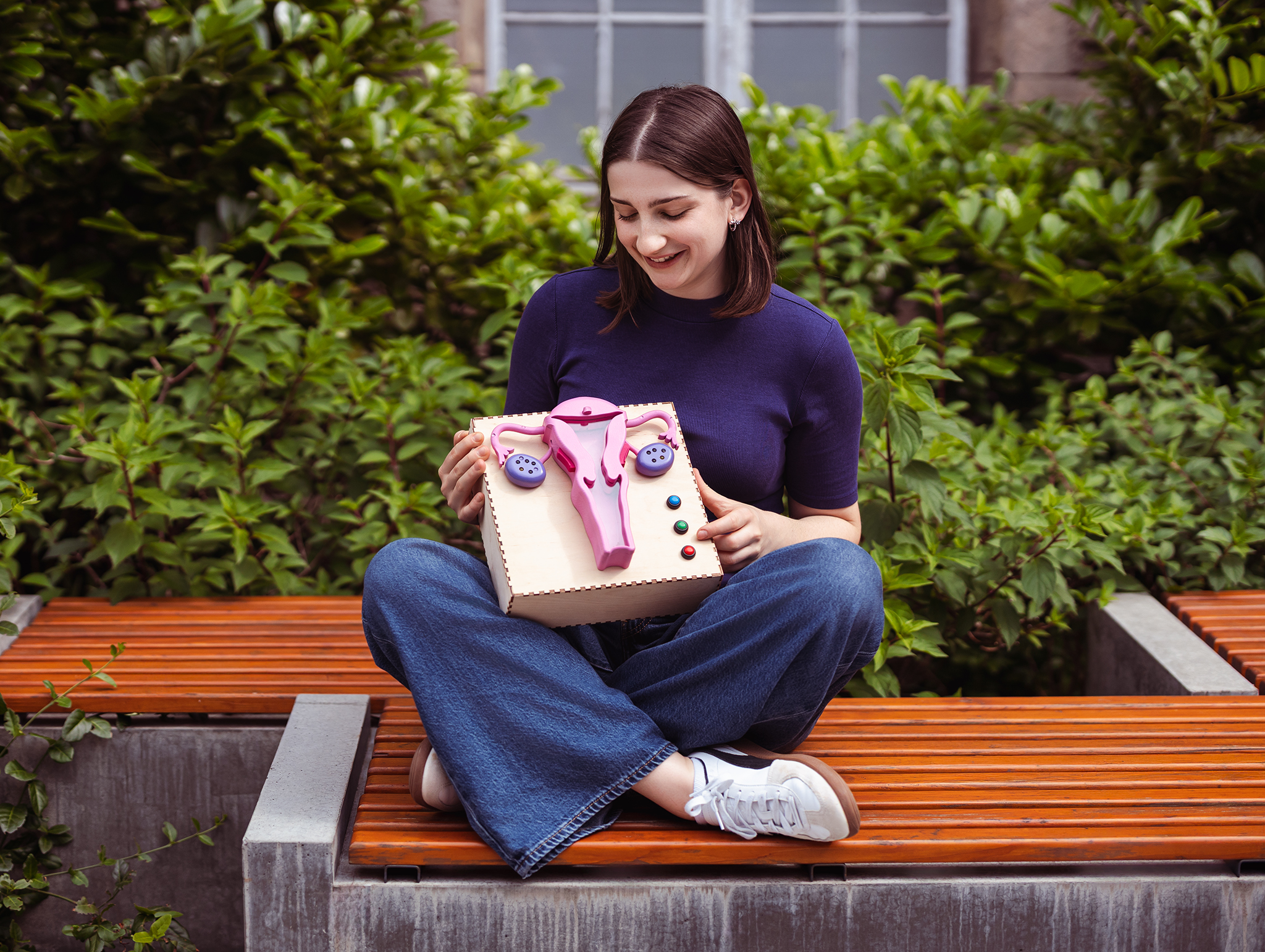
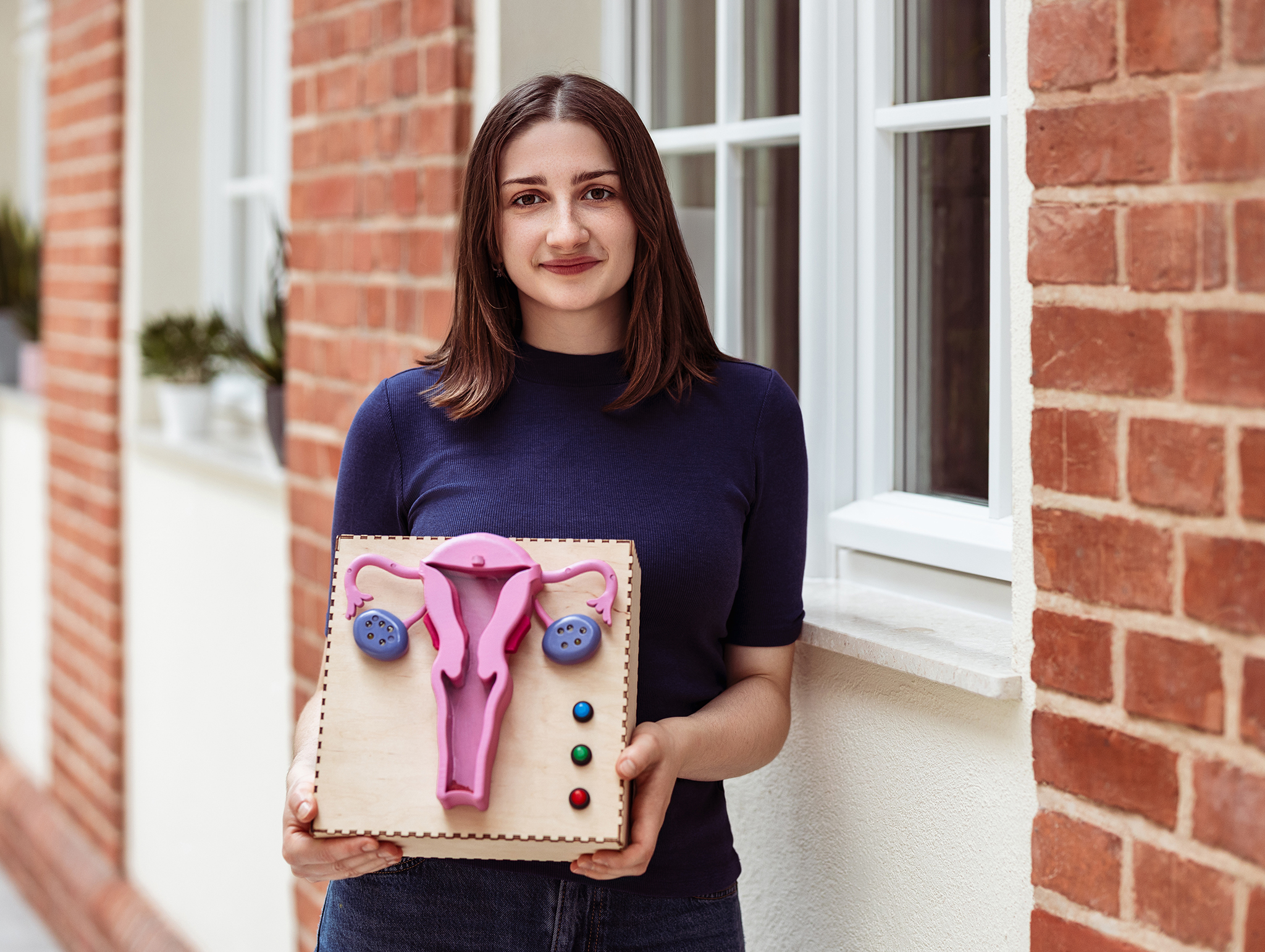
First of all, the model is three-dimensional, which makes it easier to identify the organs and remember their anatomical structure. It also has three buttons that activate different menstrual cycle modes: a typical cycle, an anovulatory cycle, which may occur in conditions such as PCOS, and a perimenopausal cycle. These modes engage the senses differently from a conventional diagram and present physiological processes dynamically, making it possible to demonstrate changes that are difficult to illustrate in a static image.
Which processes occurring during the menstrual cycle can be observed or activated using the model?
The model shows the maturation of egg cells, ovulation, the formation of the corpus luteum and menstruation. The uterine wall is movable, illustrating how it thickens during the menstrual cycle.
Will you collaborate with doctors, teachers or other specialists while developing the model and its educational materials?
Yes. While developing the current version of the model, I consulted a doctor. As part of the project, I also worked with an academic mentor and completed a university course related to this field. In the future, I would like to expand the team by involving professionals working in gynaecology. In a sense, I have already begun collaborating with teachers, who have reported a shortage of teaching tools related to the reproductive system and certain difficulties in teaching this subject. I hope that my project will help address these challenges. I would also like to test the model in schools so that it can be adapted as closely as possible to students’ and teachers’ educational needs.
Could the model also be used outside schools, for example in gynaecology practices, workshops or health-awareness campaigns?
I hope to extend the project to gynaecology practices, as I believe the model could help doctors explain individual medical cases to patients more clearly, thereby making appointments more effective. As for workshops, I am already in contact with several local organisations that are interested in participating. I hope that these activities will also help raise awareness of gynaecological health.
What were the greatest challenges involved in carrying out the project?
A very demanding schedule was a major challenge. As part of the “Universities of the Future” project, I participated in both business and academic mentoring, and I wanted to gain as much as possible from both. At the same time, I was working independently on the model while continuing my studies.
What change would you like to achieve through “The Menstrual Cycle in Action” project?
I would like girls to become more aware of their bodies and stop seeing them as something shameful or incomprehensible. Instead, I would like them to view their bodies as something fascinating and truly their own. It is also important to me that they understand how their bodies function so that they are able to recognise potentially worrying symptoms.
“The Menstrual Cycle in Action” is being carried out as part of the nationwide “Universities of the Future” project. Activities at Gdańsk University of Technology are coordinated by the Young Researchers Office. The project manager at Gdańsk Tech is prof. Mariusz Kaczmarek, Vice-Rector for Education. The student’s supervisor is Marita Mcphillips, PhD, Eng. from the Faculty of Management and Economics at Gdańsk University of Technology.
The project is coordinated by the National Centre for Research and Development.
