


Date added: 2025-05-28
Chinese cabbage in the service of science – a success story of our doctoral students

A few words about our PhD Students
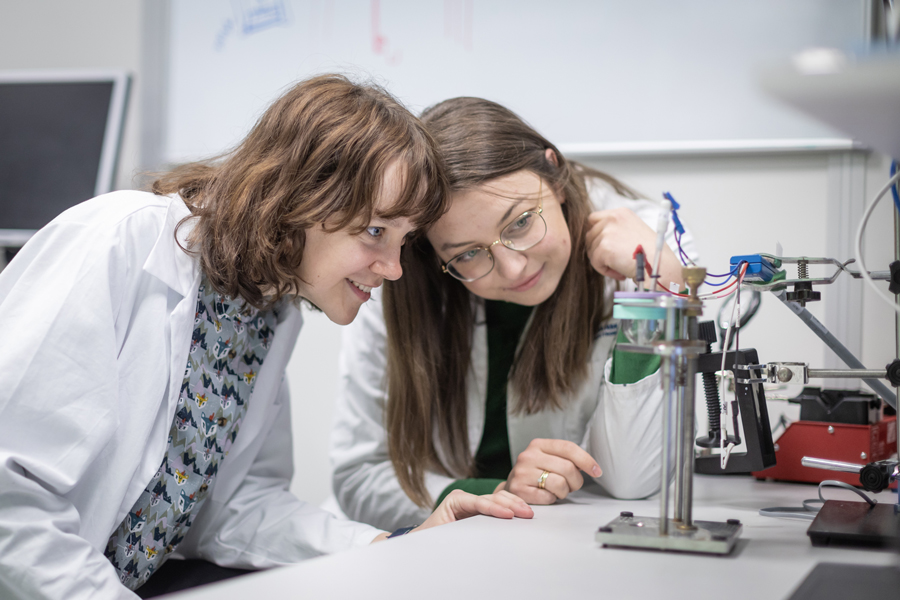
In the photo: doctoral students mgr inż. Stefania Wolff (Gdańsk Tech WFTiMS and IMP PAN) and mgr Angelika Łepek (Gdańsk Tech WFTiMS). Photo by Krzysztof Mystkowski / Gdańsk University of Technology.
mgr inż Stefania Wolff - doctoral student at the Doctoral School at Gdańsk University of Technology, scientifically affiliated with the Faculty of Applied Physics and Mathematics, began her PhD training in the a.y. 2023/2024 under the supervision of dr hab. inż. Natalia Wójcik from the Institute of Nanotechnology and Materials Engineering.
mgr inż. Angelika Łepek - doctoral student at the Doctoral School at Gdańsk University of Technology, scientifically affiliated with the Faculty of Applied Physics and Mathematics, began her PhD training in the a.y. 2023/2024 under the supervision of prof. dr hab. inż. Jackek Ryl from the Institute of Nanotechnology and Materials Engineering and dr Mattia Pierpaoli from the Department of Metrology and Optoelectronics.
How was the research conducted?
“First, we cut the cabbage leaves into pieces and soaked them in copper salts at different concentrations. Then we subjected them to pyrolysis in an inert atmosphere. This resulted in a powder containing carbon and copper, which we used to modify a glassy carbon electrode. In the next step, we studied its electrochemical properties in the detection of vitamin C, which we added to the electrolyte in a controlled manner” explains mgr Angelika Łepek.
“We showed that the material obtained from cabbage waste can be successfully used in food sensors to determine the concentration of vitamin C in fruit juice” adds mgr inż Stefania Wolff.
Publication in a prestigious journal and patent application
The research results, funded by the TECHNETIUM program, were described in the article "Transforming Organic Waste: Cabbage-Derived Carbon Containing Copper for Electrochemical Sensing of Ascorbic Acid," published in the highly ranked (200 points) journal Sustainable Materials and Technologies, and also resulted in a patent application.
The project was carried out by members of the RedOX Scientific Club: dr inż. Wiktoria Lipińska (IMP PAN, graduate of Gdańsk Tech, first author of the article), mgr Angelika Łepek, mgr inż. Stefania Wolff, as well as academic staff: prof. dr hab. inż. Jacek Ryl (Gdańsk Tech WFTiMS), dr hab. inż. Andrzej Nowak, prof. PG (Faculty of Chemistry), and dr hab. inż. Katarzyna Siuzdak, prof. IMP PAN (IMP PAN, mentor of the RedOX group and project manager).
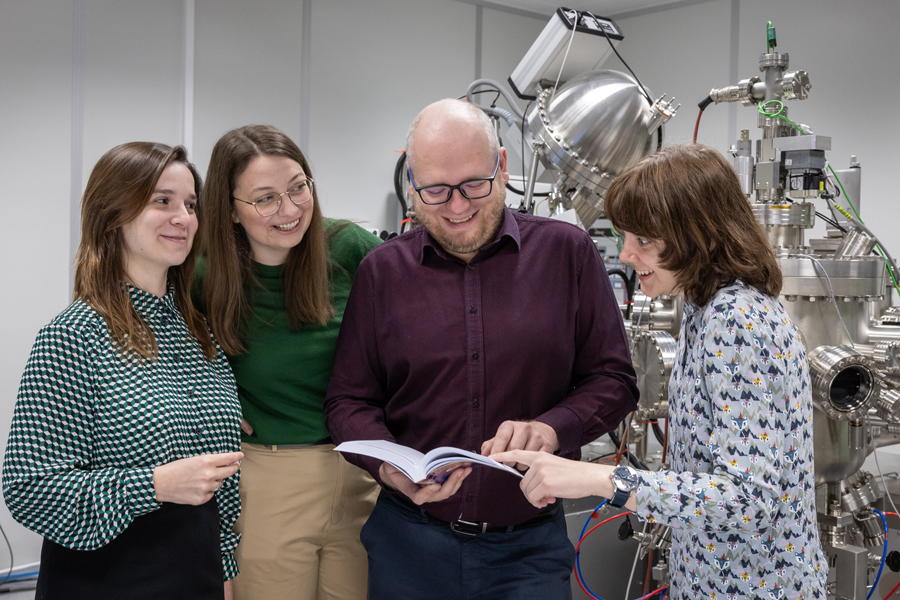
In the photo, from left: dr inż. Wiktoria Lipińska (IMP PAN, graduate of Gdańsk Tech), mgr Angelika Łepek (WFTiMS PG), prof. Jacek Ryl (WFTiMS PG), mgr inż. Stefania Wolff (WFTiMS PG and IMP PAN). Photo by Krzysztof Mystkowski / PG.
Congratulations to our doctoral students and the entire research team – your work is a perfect example of how passion and interdisciplinary collaboration can drive future innovation.
-
2026-09-14
Electro-Summer 2026 – open lectures
-
2026-09-01
7 September – Doctoral School Office closed