


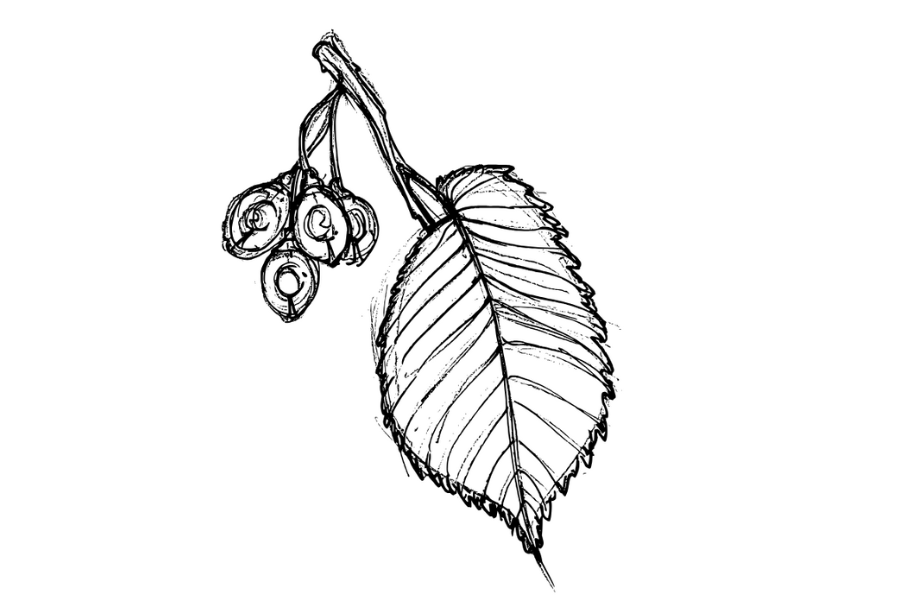
The elm, also known as limak, occurs mainly in riparian forests and moist mixed woodlands. It grows to a height of about 40 meters. Its trunk widens noticeably at the base and is often covered with short, regrowing shoots. The bark is fissured and ranges in shades of gray and brown.
Elm leaves are characteristically asymmetrical at the base, doubly serrated, and slightly hairy on the underside, giving them a grayish-green hue. This species is monoecious, and its bisexual flowers form clustered bunches borne on long stalks. The fruit is a flattened nutlet surrounded by a broad wing, which allows it to be dispersed by the wind. Limak occurs throughout Poland.
Worth knowing: Practical use of elm wood is currently limited due to Dutch elm disease. This serious disease causes the dieback of branches and limbs because the fungus infecting the tree blocks its vascular tissues. The pathogen is spread by bark beetles known as elm bark beetles.
Fun fact: Characteristic galls can often be seen on elm leaves—these are the result of feeding by small arthropods.
Source: Lasy Państwowe