


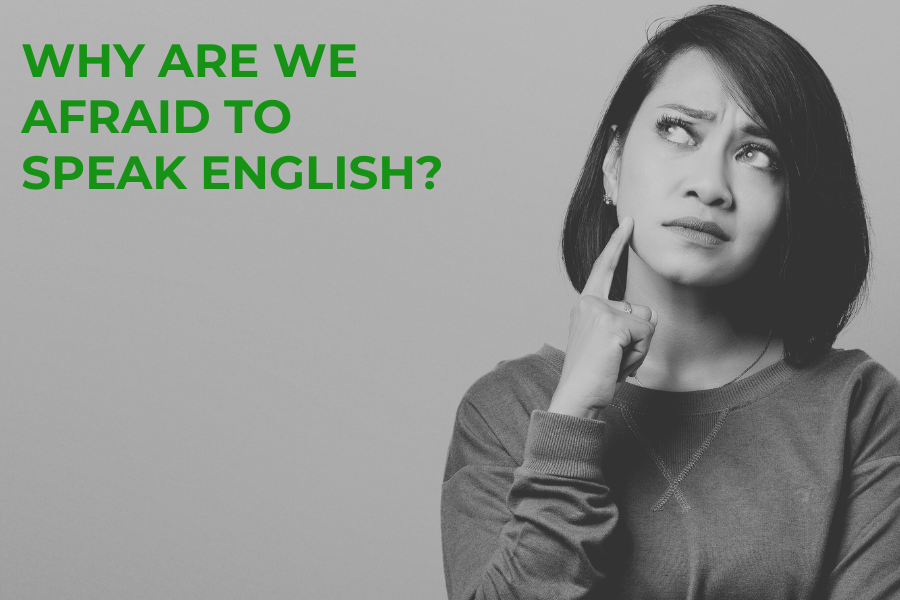
We invite you to a meeting with Jagoda Ratajczak, a philologist, translator, and author of the book Luka. Jak wstyd i lęk dziurawią nam język (The Gap: How Shame and Fear Tear Our Language), with whom we will discuss why, even after many years of learning in school, we are still afraid to speak in English.
Date: Thursday, February 27, from 11 to 1 PM
Location: conference room in the Hydromechanics building no. 11
- above the Welcome Office (campus map)
Who is it for: everyone (staff and students)
REGISTER FOR THE MEETING
About the meeting
Where do the shame and fear of speaking in a foreign language come from? What role do our expectations, the education system, and the opinions of others play in forming relationships with a new language? These and other topics will be discussed with Jagoda Ratajczak, the author of Luka. Jak wstyd i lęk dziurawią nam język, in which the philologist draws on the works of famous linguists, quotes research, and talks to teachers, polyglots, psychologists, and regular language users. The author will explain why we are ashamed of mistakes in a foreign language and why we judge our own and others' accents.
Excerpt from the book "Luka. Jak wstyd i lęk dziurawią nam język" (The Gap: How Shame and Fear Tear Our Language):
Linguicism, like racism or sexism, is a form of discrimination and oppression. It is a phenomenon in which a disciplinary tool—lecturing and ridicule—serves to promote the "ideal" form of the language and punish the use of its other variants. What does this punishment consist of? It consists of evaluating intelligence, status, education, or even health based on the language a person uses. Defending the "sanctity" of the linguistic standard, however, is an activity that not only self-proclaimed priests and priestesses of the Church of the Most Holy Correctness engage in. While sexism and racism are increasingly condemned, linguicism does not face widespread social opposition. It is accepted, even when it takes the form of quite embarrassing public corrections of others' mistakes, including online. As Katarzyna Liber-Kwiecińska writes in her report on the motivation to correct others' mistakes, "language users are not aware of the impact of linguistic ideologies and live under the assumption that their attitude toward language is purely linguistic, not ideological."
[source: https://karakter.pl/Luka-fragment-ccms-pol-43.html]

Jagoda Ratajczak – Philologist, sworn and conference translator, member of the Polish Society of Sworn and Specialized Translators (TEPIS). A graduate of the Faculty of English at Adam Mickiewicz University. Author of the book Języczni. Co język robi naszej głowie (Linguists: What Language Does to Our Minds) (2020), the first popular science publication in Poland dedicated to multilingualism, and Luka. Jak wstyd i lęk dziurawią nam język. As a member of TEPIS and a translator with fourteen years of practice, she teaches translation to aspiring professionals and other practicing translators. On her social media, she popularizes knowledge about linguistics and specialized translation, including legal English. She lives in Poznań.