
A Waste Collection Vessel Will Be Built. Agreement Signed for Project Implementation
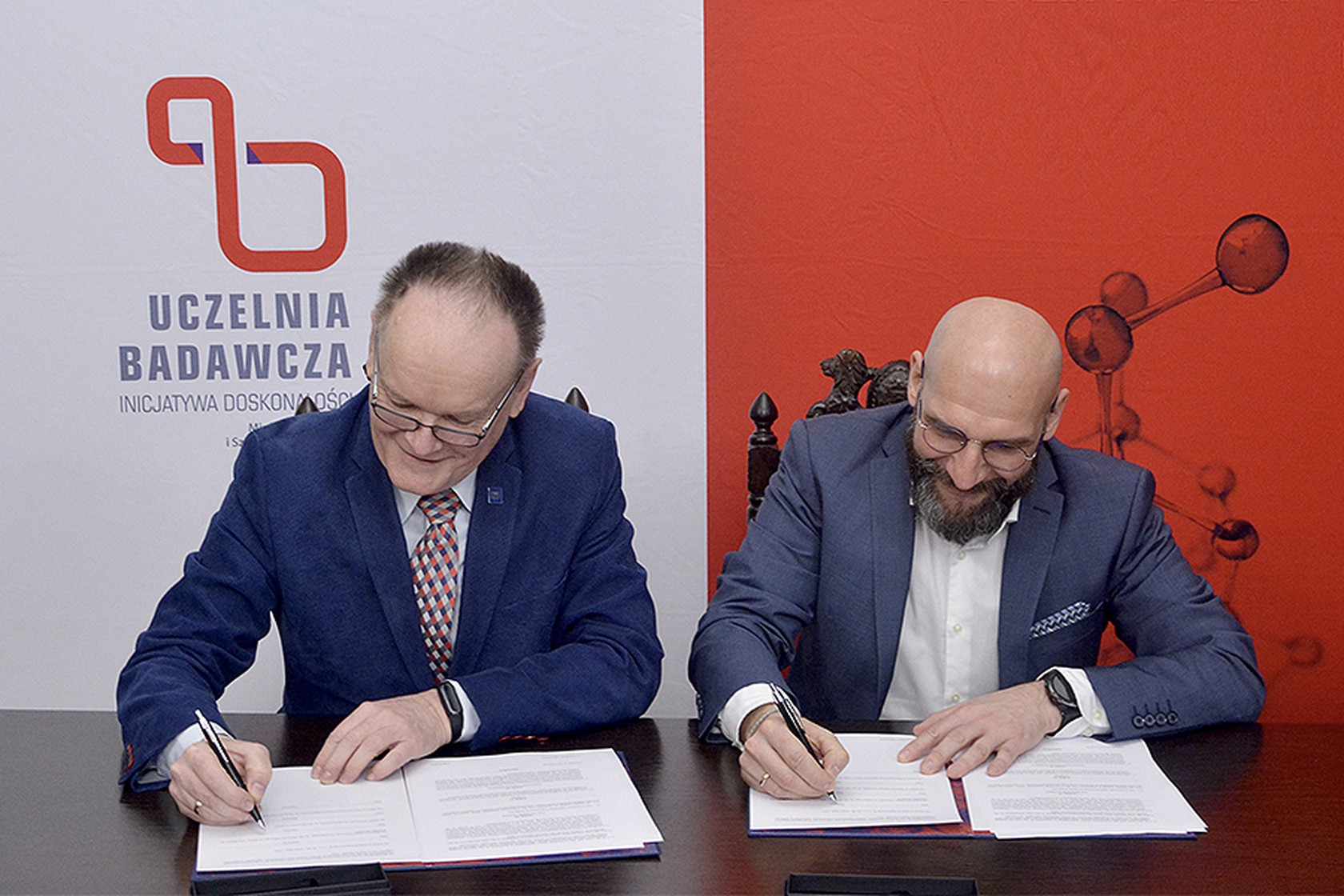
An autonomous vessel will be created, which will collect waste from the water and other ships, and will be powered by electric energy. On April 5, Prof. Sławomir Milewski, Vice-Rector for Research, and Adam Ślipy, President of the Management Board of Seatech Engineering, signed a consortium agreement for the implementation of the project.
An autonomous vessel will be created, which will collect waste from the water and other ships, and will be powered by electric energy. On April 5, Prof. Sławomir Milewski, Vice-Rector for Research, and Adam Ślipy, President of the Management Board of Seatech Engineering, signed a consortium agreement for the implementation of the project.
The project "Zero-Emission Ship for Collecting Pollution in Ports and Coastal Areas" (acronym: ZeroWastePorts) will be carried out by a Polish-Taiwanese consortium. On the Polish side, it includes, as the leader, the design office Seatech Engineering and Gdańsk Tech, and on the Taiwanese side, National Taiwan University and the Ship and Ocean Industries R&D Center. The cooperation within ZeroWastePorts forms an ideal basis for intercontinental exchange of knowledge and experience through the joint use of the design office’s expertise, previous scientific research results conducted at Gdańsk Tech and NTU, and research infrastructure.
Project Objectives
The primary objective of the ZeroWastePorts initiative is to develop a preliminary design of an autonomous waste collecting vessel (WCV) powered by electric energy. The main function of the vessel will be to collect waste both from the water and to receive it from other ships. The vessel will be adapted for operation in open waters as well as in navigationally challenging restricted areas (ports, marinas, inland waterways).
The specific objectives of the project are:
- designing a hull shape with good stability, low fuel consumption, and excellent maneuvering characteristics,
- developing algorithms for waste detection and autonomous navigation modes,
- designing and optimizing the electric power system onboard the vessel,
- designing a shore station for waste collection and vessel battery charging,
- assessing the feasibility of implementing the WCV concept globally in various ports.
Modularization, Autonomy, and Electrification
The originality of the project is based on three pillars: modularization, autonomy, and electrification. In all these areas, the project will contribute at an international scientific level.
The project activities will utilize the most advanced research methods, including model tests and computational fluid dynamics (CFD). These methods will be used mainly to evaluate the efficiency of propulsion and the maneuverability of the vessel. Additionally, machine learning techniques will be applied for waste detection and autonomous trajectory planning, as well as a ship simulator for real-time analysis of vessel responses.
The consortium operates under the financing program of the ninth call for joint bilateral projects within Polish-Taiwanese cooperation. The Polish part is supported by the National Centre for Research and Development (NCBiR), while the Taiwanese part is supported by the Ministry of Science and Technology (MOST).
The project will be carried out under the direction of PhD Eng. Maciej Reichel in an interdepartmental team of scientists from the Institute of Ocean Engineering and Ship Technology, Faculty of Mechanical Engineering and Ship Technology.