
Bisacridines, anticancer compounds in 3D cell cultures
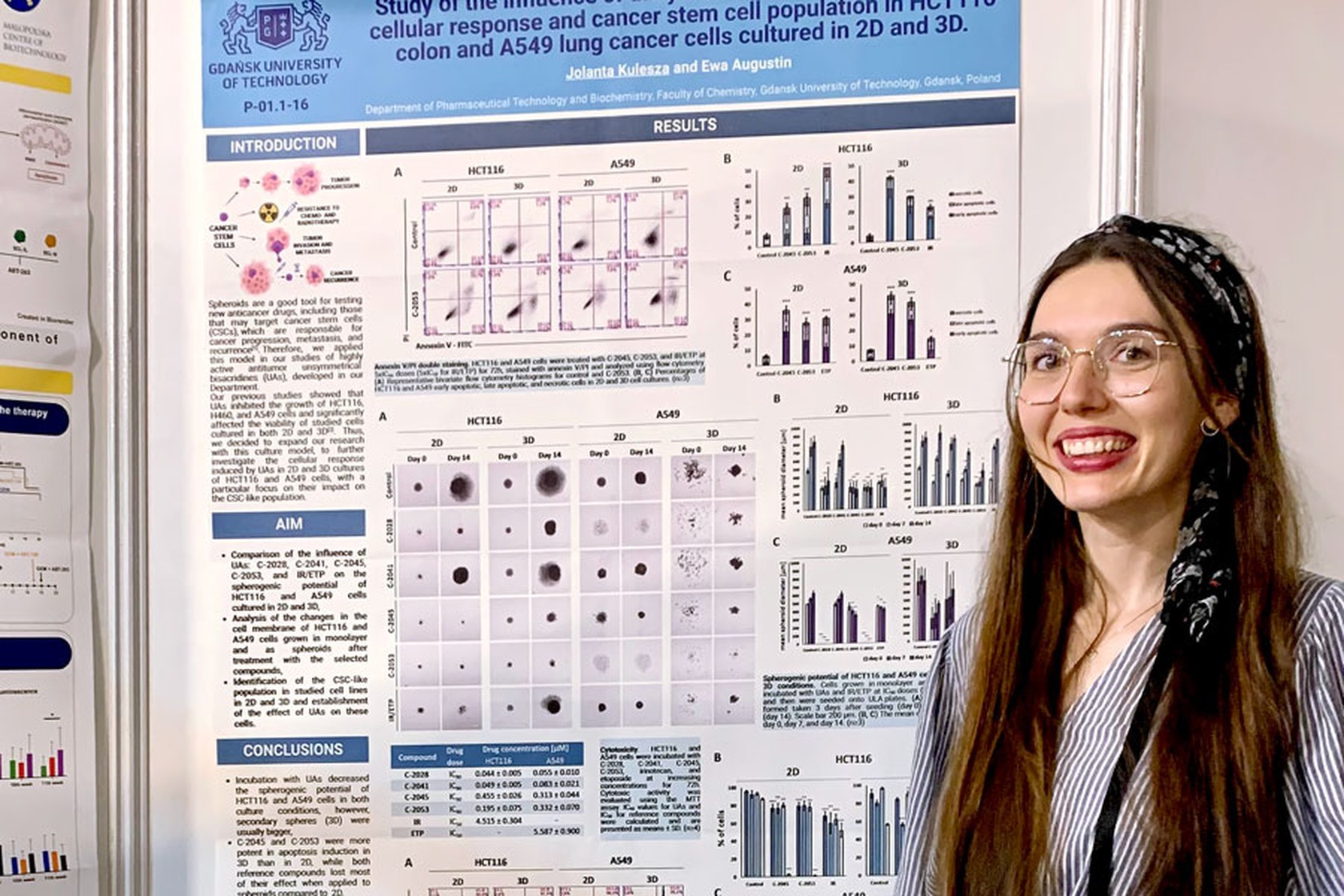
Jolanta Kulesza, a graduate of the Doctoral School at Gdańsk Tech, used spheroids, that is 3D cell cultures, in her doctoral thesis to evaluate anticancer compounds under conditions similar to those found in tumors.
Jolanta Kulesza, a graduate of the Doctoral School at Gdańsk Tech, used spheroids, that is 3D cell cultures, in her doctoral thesis to evaluate anticancer compounds under conditions similar to those found in tumors.
The doctoral dissertation entitled "Comparison of 2D and 3D culture models in the studies of the biological response induced by unsymmetrical bisacridines in cancer cells" was written under the supervision of prof. Ewa Augustin from the Department of Drug Technology and Biochemistry at the Faculty of Chemistry.
– As part of my doctoral research, I conducted studies on the mechanism of action of new, highly active anticancer compounds – unsymmetrical bisacridines, which were synthesized and patented by the Team of Chemistry and Biochemistry of Anticancer Compounds in the Department of Drug Technology and Biochemistry – explains Jolanta Kulesza. – During my research, for the first time in our team, I utilized 3D cell cultures, so-called spheroids, which are an experimental model that allows the assessment of anticancer compound activity under conditions comparable to those prevailing in a tumor. Compared to traditional 2D monolayer cultures, where cells grow flatly attached to the bottom of a vessel, the three-dimensional structure of spheroids and the existing gradients of pH, oxygen, nutrients, and metabolites make this model better reflect the conditions present in tumors in vivo.
Using spheroids in her studies, the doctoral candidate conducted extensive research on the cellular response induced by unsymmetrical bisacridine derivatives in lung cancer and colorectal cancer cells cultured in 3D conditions, as well as for comparison, in 2D conditions. Additionally, she performed a preliminary analysis of the effects of the studied compounds on the population of cells exhibiting characteristics of cancer stem cells, which are considered responsible for resistance to anticancer therapy, cancer progression, metastasis, and disease recurrence, making them a promising target in cancer treatment.
Jolanta Kulesza became interested in cancer diseases and their treatment already during her engineering studies. Her engineering thesis concerned pancreatic cancers. Subsequently, continuing her interest in this field, she conducted a series of experiments on the basis of which she wrote her master's thesis entitled "Cellular response induced by the derivative 9-amino-1-nitroacridine, C-1748, in human colon and lung cancer cells."
– I believe that my doctoral studies significantly contributed to the development of my independence and my ability to plan and manage my time. Beyond the obvious advantages, such as gaining in-depth knowledge in my field, doctoral studies also developed my research competencies, data analysis skills, and scientific writing abilities. As for the drawbacks, the biggest challenge for me was the high level of stress and anxiety related both to the doctoral studies themselves and the process of publishing results. However, despite these difficulties and numerous moments of doubt, I do not regret my decision – emphasizes the researcher.