
Multicomponent Niobates. Ceramic Materials in Hydrogen Technologies
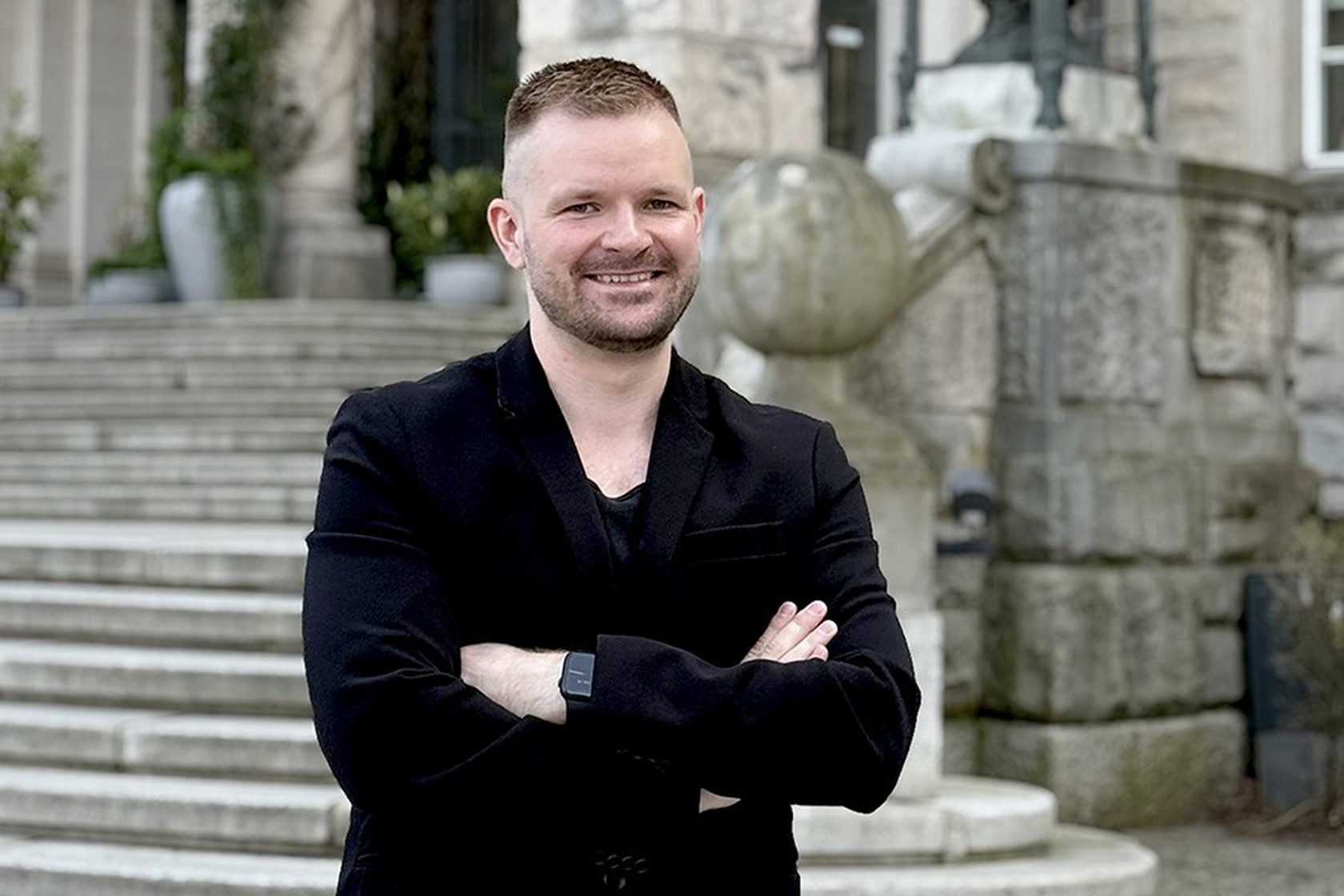
Arkadiusz Dawczak, a graduate of the Doctoral School at Gdańsk Tech, conducts research on advanced ceramic materials that may find applications in technologies related to the production and use of hydrogen.
Arkadiusz Dawczak, a graduate of the Doctoral School at Gdańsk Tech, conducts research on advanced ceramic materials that may find applications in technologies related to the production and use of hydrogen.
His doctoral dissertation “Structural, thermal and electrical properties of multicomponent rare-earth ortho-niobates” was written under the supervision of Prof. Maria Gazda, PhD, DSc, Eng., and the reviewers are: Prof. Izabela Szafraniak-Wiza, PhD, DSc from Poznań University of Technology, Prof. Tomasz Goryczka, PhD, DSc from the University of Silesia in Katowice, and Prof. Tomasz Brylewski, PhD, DSc, Eng. from the Stanisław Staszic AGH University of Science and Technology in Kraków.
Arkadiusz Dawczak’s research focuses on advanced ceramic materials that may find applications in technologies related to hydrogen production and use.
– Modern science is seeking materials capable of efficiently conducting hydrogen ions (protons) at lower temperatures than the currently used 500 – 650 °C. Such materials are crucial for the development of devices such as protonic ceramic fuel cells, which convert hydrogen into electrical energy, electrolyzers with ceramic proton conductors, enabling the decomposition of water vapor into hydrogen and oxygen, and gas sensors (e.g. for hydrogen) – explains the scientist. – All these devices require materials that are chemically and thermally stable and exhibit high proton conductivity.
The aim of the dissertation was to investigate whether increasing the complexity of the chemical composition in the structure of rare-earth niobates, i.e. adding various elements, can improve their properties, making them more suitable for the aforementioned applications. For this purpose, three series of single-phase compounds with complex chemical compositions were synthesized by the solid-state method and then subjected to detailed analysis.
The obtained results indicated that all the studied series of compounds are thermodynamically stable and exhibit proton conductivity. Moreover, it was found that increased chemical composition complexity in the rare-earth cation sublattice improves the solubility of acceptor dopants, leading to the formation of a higher concentration of proton defects in humid atmospheres. This phenomenon is beneficial for proton conductivity and may contribute to improving the properties of materials used in advanced electrochemical devices.
– My work was conducted within the research project "High-entropy oxides for energy conversion," funded by the National Science Centre under the OPUS 18 program. The reviewers noted that the dissertation makes a significant contribution to the development of advanced ceramic materials that can be applied in technologies related to renewable energy and hydrogen production. The use of such materials can increase the efficiency and durability of electrochemical devices, which is crucial in the context of global energy challenges. The work was highly rated, and its results may provide a valuable contribution to the development of modern technologies related to energy conversion – emphasizes Arkadiusz Dawczak.
The scientist has been affiliated with Gdańsk Tech from the beginning of his studies, specifically with the Faculty of Applied Physics and Mathematics.
– My engineering and master’s studies, and especially participation in a research project, allowed me to gain experience in modifying material properties and their analysis. This strengthened my conviction that materials engineering is the discipline in which I want to pursue my scientific career. Studies at the Doctoral School at Gdańsk Tech gave me the opportunity to develop through research work in modern laboratories and collaboration with foreign research centers. One such place was the European Synchrotron Radiation Facility in Grenoble, where I conducted part of my research. An important aspect of the studies was also the possibility to participate in scientific conferences, which enabled exchange of experiences and presentation of research results. I took part in seven conferences – I delivered oral presentations at three of them and presented posters at the others. My scientific output includes five articles published in international journals listed in Journal Citation Reports, of which I am the first author of two, and three are directly related to the topic of my doctoral dissertation – he summarizes.
Studies at the Doctoral School taught me, above all, humility, patience, and good work organization. If I had to make the decision to start them again, I would do so without hesitation, especially since the educational program is now very well organized and many scholarship opportunities are offered to doctoral students.
After defending his dissertation, Arkadiusz Dawczak plans to take up work in a research laboratory where he can apply the knowledge and experience gained during his doctorate. He is also considering the possibility of working in a post-doc position, especially if an interesting offer in his field arises.