
Ionic liquids. They will purify exhaust gases and be useful in dentistry
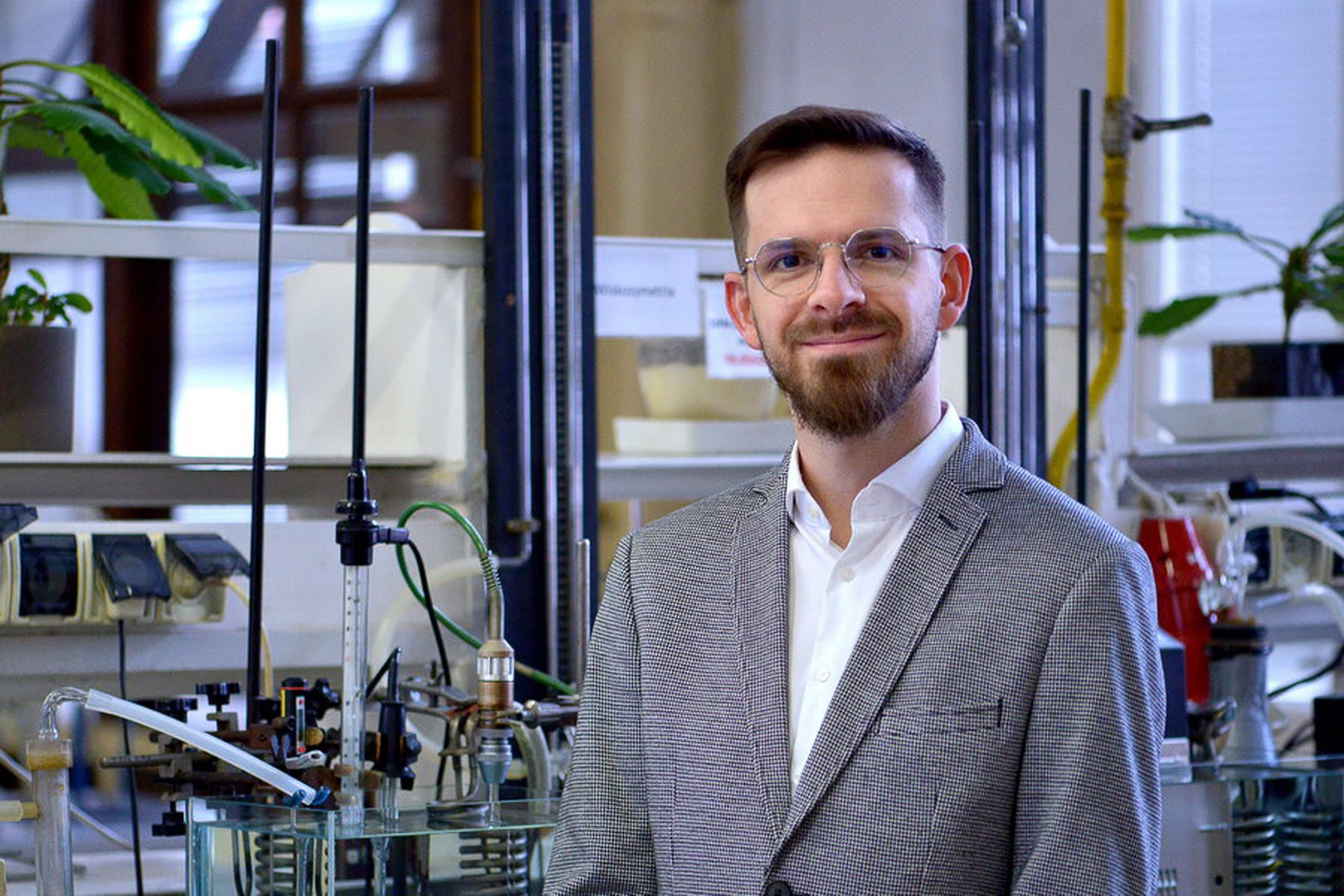
How to predict the properties of compounds without expensive and time-consuming experiments? Dr. Eng. Joachim Eichenlaub, a graduate of the Doctoral School at Gdańsk Tech, used mathematical modeling, which allows linking the chemical structure of molecules with their physicochemical properties. He mainly studied ionic liquids as carbon dioxide absorbers from flue gases. Now he will develop this research in dentistry.
How to predict the properties of compounds without expensive and time-consuming experiments? Dr. Eng. Joachim Eichenlaub, a graduate of the Doctoral School at Gdańsk Tech, used mathematical modeling, which allows linking the chemical structure of molecules with their physicochemical properties. He mainly studied ionic liquids as carbon dioxide absorbers from flue gases. Now he will develop this research in dentistry.
Ionic liquids are chemical compounds composed exclusively of ions that exist in a liquid state at low temperatures (often room temperature). They are used, among others, in chemistry and industry as "green" solvents or as electrolytes in batteries and electronics.
Dr Eng. Joachim Eichenlaub, a graduate of the Faculty of Chemistry in two fields – chemical technology and corrosion, as well as the Doctoral School at Gdańsk Tech, and also a graduate and employee of the Medical University of Gdańsk (Department of Dental Prosthetics), addressed the topic of ionic liquids in his doctoral dissertation titled "The use of QSPR modeling to predict the physicochemical properties of ionic liquids."
– QSPR mathematical modeling involves describing the structural features of a molecule using numbers, so-called molecular descriptors, and then searching for relationships between these numbers and physicochemical properties, such as density, viscosity, solubility – explains Dr Eng. Joachim Eichenlaub. – First, we properly prepare and optimize the molecular structure, then calculate the descriptors, and finally build a mathematical model that links them to the observed properties. Thanks to this, we can predict the properties of ionic liquids for compounds that have not undergone costly and time-consuming experiments.
As the scientist emphasizes, such models allow for a better understanding of structural features and molecular mechanisms responsible for certain properties, and based on this, new molecules with specific properties can be designed in the future.
– In my research, this concerned ionic liquids, which are potentially less harmful to the environment than conventional solvents, and their ability to dissolve carbon dioxide, which is significant in the context of capturing it from industrial emissions – says the graduate of the Doctoral School at Gdańsk Tech. – I successfully linked solubility to the structural features of molecules. The research also showed that the method of optimizing the molecular structure has little impact on modeling results, while the choice of modeling method is crucial – he adds.
The research was carried out in the team of Prof. Adam Kloskowski from the Department of Physical Chemistry at the Faculty of Chemistry, Gdańsk Tech, who was also the doctoral supervisor. In cooperation with other researchers: Dr hab. Eng. Maciej Śmiechowski, Prof. Gdańsk Tech, MSc Eng. Karol Baran, data for 73 ionic liquids were used for modeling.
Dental Materials with Appropriate Properties
Dr Eng. Joachim Eichenlaub also uses mathematical modeling in the study of dental materials.
– In our team at the Medical University of Gdańsk, we investigated the density and surface tension of monomers used in dental composites. This allowed us to determine relationships and select compositions (e.g., acrylics for dentures, temporary crowns, or fillings) to obtain materials with appropriate properties and user-friendly – he says.
Now the scientist is starting research on the toxicity of ionic liquids against bacteria inhabiting the oral cavity.
– We want to check whether ionic liquids have bactericidal or bacteriostatic applications –
he adds and announces that he will conduct the research in cooperation with the Faculty of Chemistry at Gdańsk Tech.
A Scientist by Calling Who Enjoys Teaching Students
– Studying at the Doctoral School involves many sacrifices, but it provides even greater satisfaction – says Dr Eng. Eichenlaub, who simultaneously with his doctorate studied dentistry. – It is important which team you are in and, of course, to have a good supervisor. Then you can do serious science.
The young scientist emphasizes that teaching gives him great pleasure.
– I really enjoy classes with students. It brings me a lot of joy, especially when I work with first-year students and see their progress. I try to help them "grasp" the knowledge, show that they can manage it, but also from the very beginning to introduce how their future work as dentists will look like.