
Faculty of Architecture at Gdańsk Tech and Gdynia Expand Cooperation
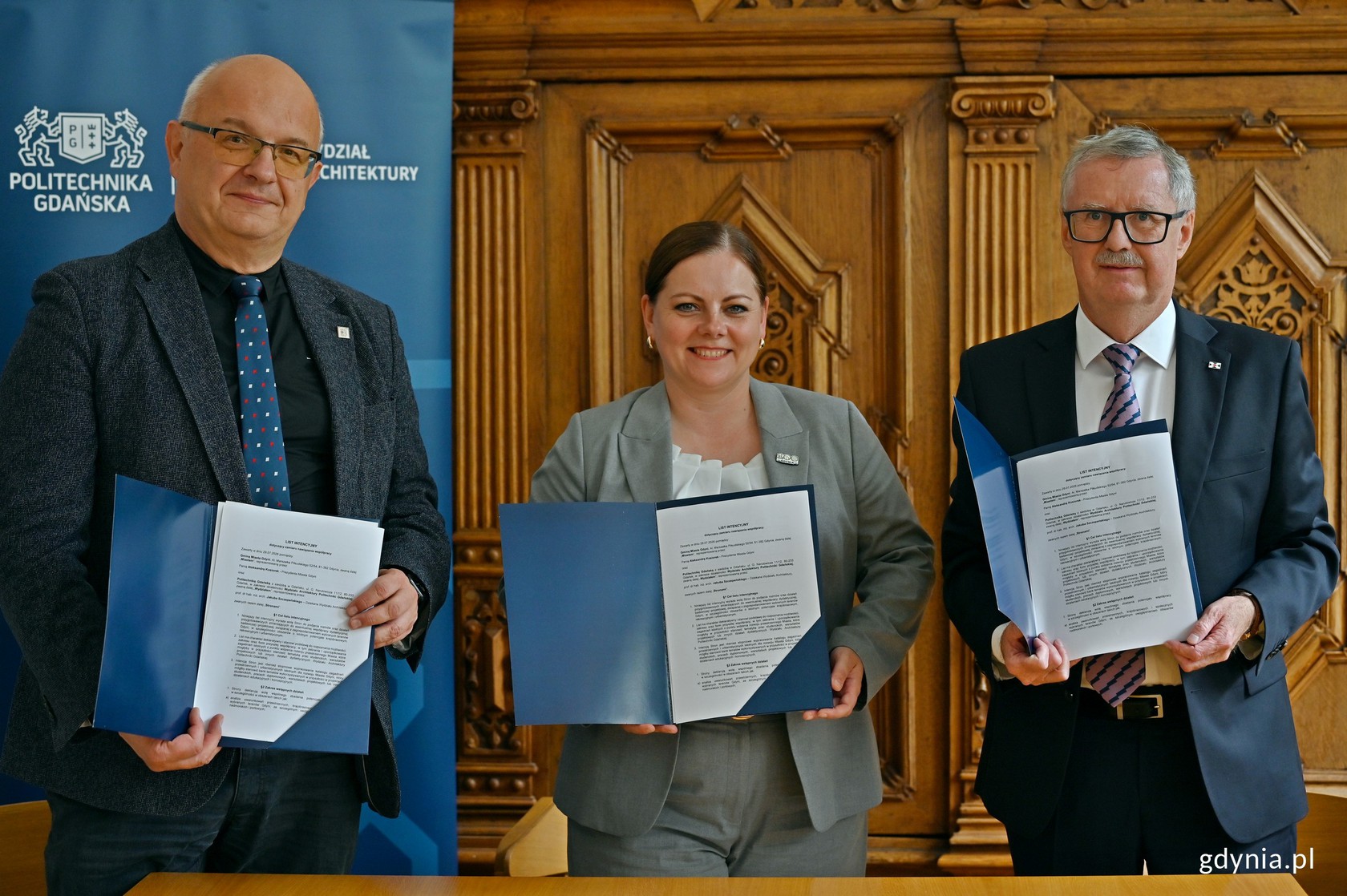
Gdańsk Tech and the City of Gdynia signed a letter of intent on July 29 concerning future educational, research, and design collaboration. Gdynia's spatial and urban challenges may in the future become topics for student projects, theses, workshops, and conceptual competitions.
Gdańsk Tech and the City of Gdynia signed a letter of intent on July 29 concerning future educational, research, and design collaboration. Gdynia's spatial and urban challenges may in the future become topics for student projects, theses, workshops, and conceptual competitions.
The document was signed by Aleksandra Kosiorek, Mayor of Gdynia, Prof. Dariusz Mikielewicz, Vice-Rector for Research, and Prof. Jakub Szczepański, Dean of the Faculty of Architecture at Gdańsk Tech. The meeting was also attended by Dr Eng. Arch. Paulina Szewczyk, City Architect of Gdynia and Assistant Professor at the Department of Spatial Planning at the Faculty of Architecture at Gdańsk Tech, as well as the faculty’s vice-deans – Prof. Karolina Krośnicka and Prof. Magdalena Podwojewska.
“Gdynia has been a modern and bold city in its spatial thinking since its inception. It was founded a hundred years ago thanks to daring visions, and its unique modernist heritage was recognized by its inclusion on the UNESCO World Heritage List,” says Aleksandra Kosiorek, Mayor of Gdynia. “We want to continue this tradition but in line with contemporary challenges. That is why we value cooperation with young architects who bring fresh perspectives, innovative ideas, and courage in seeking new solutions. Equally important to us is understanding the needs and expectations of the younger generation, as they will be the ones shaping Gdynia’s future. I believe that collaboration with the Faculty of Architecture at Gdańsk Tech will generate valuable concepts that will inspire Gdynia’s development.”
“It is extremely important for us that students can work on real and complex spatial and architectural challenges grounded in a specific urban context. Cooperation with Gdynia creates such an opportunity. We are especially pleased to sign this letter in the year when Gdynia celebrates the centenary of its city rights and shortly after the modernist city centre was inscribed on the UNESCO World Heritage List,” says Prof. Jakub Szczepański, Dean of the Faculty of Architecture at Gdańsk Tech.
Gdynia as a Space for Research and Projects
The cooperation will focus on selected areas of Gdynia, particularly coastal and port zones, as well as places with significant landscape, recreational, and urban potential. The first stage will involve identifying the city’s key spatial challenges and how they can be utilized in the didactic and project activities of the Faculty of Architecture at Gdańsk Tech.
The parties intend to gradually develop a catalogue of issues that could serve as topics for semester projects, theses, workshops, conceptual competitions, and other educational activities. The faculty will also consider incorporating Gdynia’s spatial and urban themes into the curricula of courses offered.
“Gdynia will gain new, fresh ideas and perspectives from young people who will live and work here in the future. It is worth getting to know their viewpoint. We need innovation because there is no development without it. This knowledge and innovation are precisely what the Faculty of Architecture at Gdańsk Tech offers,” comments Dr Eng. Arch. Paulina Szewczyk, City Architect of Gdynia and Assistant Professor at the Department of Spatial Planning at the Faculty of Architecture at Gdańsk Tech. “It will also be highly motivating for students if they can work on real topics, within real conditions and documentation.”
The City of Gdynia has declared its readiness to provide basic information and planning materials and to offer substantive support regarding local conditions. The Faculty of Architecture at Gdańsk Tech has declared its readiness to involve academic staff and students in analytical and design work related to areas indicated by the city.
Gdynia on the UNESCO World Heritage List
The signing of the letter of intent extends the long-standing cooperation between Gdynia and Gdańsk Tech in the fields of architecture, urban planning, and heritage protection. The document was signed just two days after the announcement of the inclusion of Gdynia’s modernist city centre on the UNESCO World Heritage List. The efforts for the inscription lasted many years, and the final success is the result of diplomatic activities and the work of many groups, and a testament that dialogue and cooperation can bring tangible benefits. The process was initiated by former Vice-Mayor of Gdynia Marek Stępa and continued by current city authorities with the engagement of many individuals. Scientists from the Faculty of Architecture at Gdańsk Tech also participated in preparing the nomination, including Prof. Maria Jolanta Sołtysik, Dr hab. Eng. Arch. Robert Hirsch, and Dr Eng. Arch. Marek Stępa.
Gdynia was recognized for features not found in other cities with similar architecture. These include a compact, carefully planned downtown with a high quality of living spaces, designing the city in harmony with the sea and port, outstanding tenement houses and buildings featuring rich and coherent architectural forms, and the preservation of historic functions, authenticity, and integrity of the entire area. In summary, Gdynia’s modernist city centre is simply one of the best-preserved examples of a 20th-century modern port city in the world.