
KSTO KORAB with a silver medal at Krakow Solar Boat Challenge
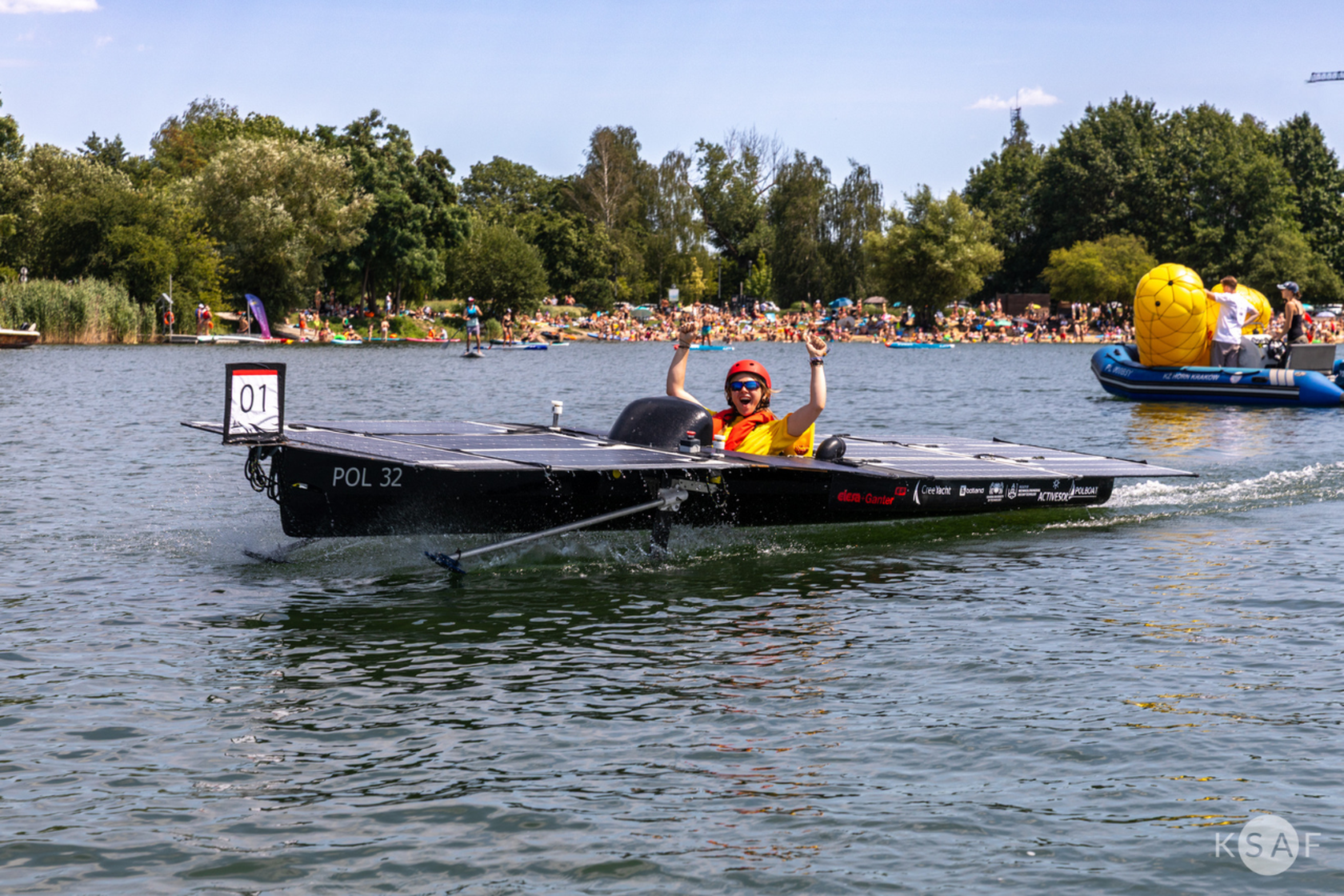
Students from the Ship Technology Student Circle KORAB at Gdańsk Tech took second place in the overall classification of the first edition of the Krakow Solar Boat Challenge. They won the Time Trial competition and finished the entire event just one point behind the host team representing the AGH University of Science and Technology in Kraków.
Students from the Ship Technology Student Circle KORAB at Gdańsk Tech took second place in the overall classification of the first edition of the Krakow Solar Boat Challenge. They won the Time Trial competition and finished the entire event just one point behind the host team representing the AGH University of Science and Technology in Kraków.
The international solar-powered boat competition took place from July 23 to 26 on the Bagry Reservoir. Four teams participated in the competition: AGH Solar Boat and GT Solar Boat Team from Poland, and BME Solar Boat Team and Pannon Solar Boat Team from Hungary. The boats were tested in five events demanding speed, agility, efficient energy management, and reliability. In Krakow, the hydrofoil started and completed all five events without any serious failure.
POL32 was the only vessel moving fully in flight on hydrofoils. Elevating the hull above the water surface significantly reduces hydrodynamic resistance, allowing the boat to achieve higher speeds with lower energy consumption.
Pre-race tests
Before the hydrofoil launched, the team detected damage to the streamlined housing of the propulsion column. Thanks to the help of the hosts from AGH, the part was reprinted on-site with modified geometry, and the problem was solved before the points-based competitions began.
During the tests, POL32 also set a new speed record (over 42 km/h), using aluminum propellers produced in cooperation with the Ship Design Center.
No sun? Efficiency decides
The first event was the Time Trial. Lack of sunlight meant that the result depended on the energy stored in the batteries and the efficiency of the entire construction. Replenishing losses from current photovoltaic panel production was not possible.
Over a course length of approximately 14 km, POL32 won with an average speed of 18.5 km/h, while maintaining a safe energy reserve in the battery. The result confirmed a very favorable ratio of boat speed to energy consumption and the advantage of hydrofoils over longer distances. Reducing hydrodynamic drag allowed the boat to travel faster without a proportional increase in power consumption.
– Our goal was not to build the largest lead, but a certain victory with the least possible energy consumption. Points were awarded for places achieved, not for time differences, so additional battery use would not have brought us any benefits – says Julian Serkieza from KSTO KORAB.
On long straight sections, the boat moved on hydrofoils, while before the tightest turns it returned to displacement mode. Returning to flight requires a significant amount of energy, so the team used hydrofoils only where reducing resistance brought real gains.
KSTO Korab in the lead
During the Endurance event, conditions were sunny, giving an advantage to the AGH vessel equipped with a more efficient photovoltaic system. POL32 completed 23 laps of 1.82 km each – nearly 42 km in total – and took second place. Again, the team did not try to catch up with the leader at all costs. The priority was to maintain an advantage over the Hungarian teams and conserve energy for the slalom that started shortly after the Endurance concluded.
In the first slalom run, performed in displacement mode, POL32 achieved the second-best time, just behind the BME team. AGH’s last place in this event propelled the Gdańsk students into the overall lead. The good result on the first attempt allowed the second run to be treated as an experiment to test the boat’s behavior on hydrofoils in tight turns.
The test showed that the current hull and flight control system are not yet adapted to such a tight course. The hydrofoil missed one turn and bypassed a buoy, but the run provided the team with data needed for further development of the design.
Two seconds from a different outcome
In the Speed Race, POL32 took fourth place. Achieving full acceleration was hampered by a turn, temporary issues with the throttle potentiometer, and the initial placement of additional ballast. Before the closing Match Race, the teams from Gdańsk and Krakow both had 12 points, so the final competition decided the overall victory.
– Speed Race showed how precise the balance must be for a hydrofoil moving on foils. Initially, 12 kg of ballast placed too close to the bow caused it to submerge, but after shifting the mass, the problem disappeared completely. We were able to apply the conclusions from this run immediately in the Match Race, where the competition remained very close until the very end. We lacked just two seconds for a better result – says Joanna Rakieć from KSTO KORAB.
POL32 finished the Match Race in third place. Ultimately, AGH Solar Boat won the overall classification with 14 points, while GT Solar Boat Team took second place with 15 points.
The Krakow competition was not only a sporting contest for the team but also a full-scale research and development test. Data from the five completed events allowed comparing energy consumption during flight on hydrofoils and displacement sailing, assessing the steering system’s behavior in tight turns, and examining the influence of mass distribution and propulsion configuration on the boat’s performance.
The project allows students to combine knowledge of hydrodynamics, ship construction, electric propulsion, automation, and data analysis, going through the entire process – from design and construction to verifying the boat in real racing conditions.
– Our greatest success is not just the second place, but that the boat worked exactly as we designed it. It completed all the events, flew where it was energetically profitable, and required no serious repairs throughout the competition – emphasizes Julian Serkieza.
The team representing Gdańsk Tech consists of: PhD Eng. Michał Struk, Wojciech Wierzbicki, Joanna Rakieć, Olgierd Matecki, Marek Oerlich, Isabel Cristina Bennassar Wojtowicz, and Julian Serkieza.
The next challenge will be the competition at Lake Balaton at the end of August. The team intends to use the collected data to further refine the control system, mass distribution, and drive configuration in order to maintain the achieved reliability and return to competing for victory.