
Electronics that adapts to the brain. PLN 4 million for a researcher from Gdańsk Tech
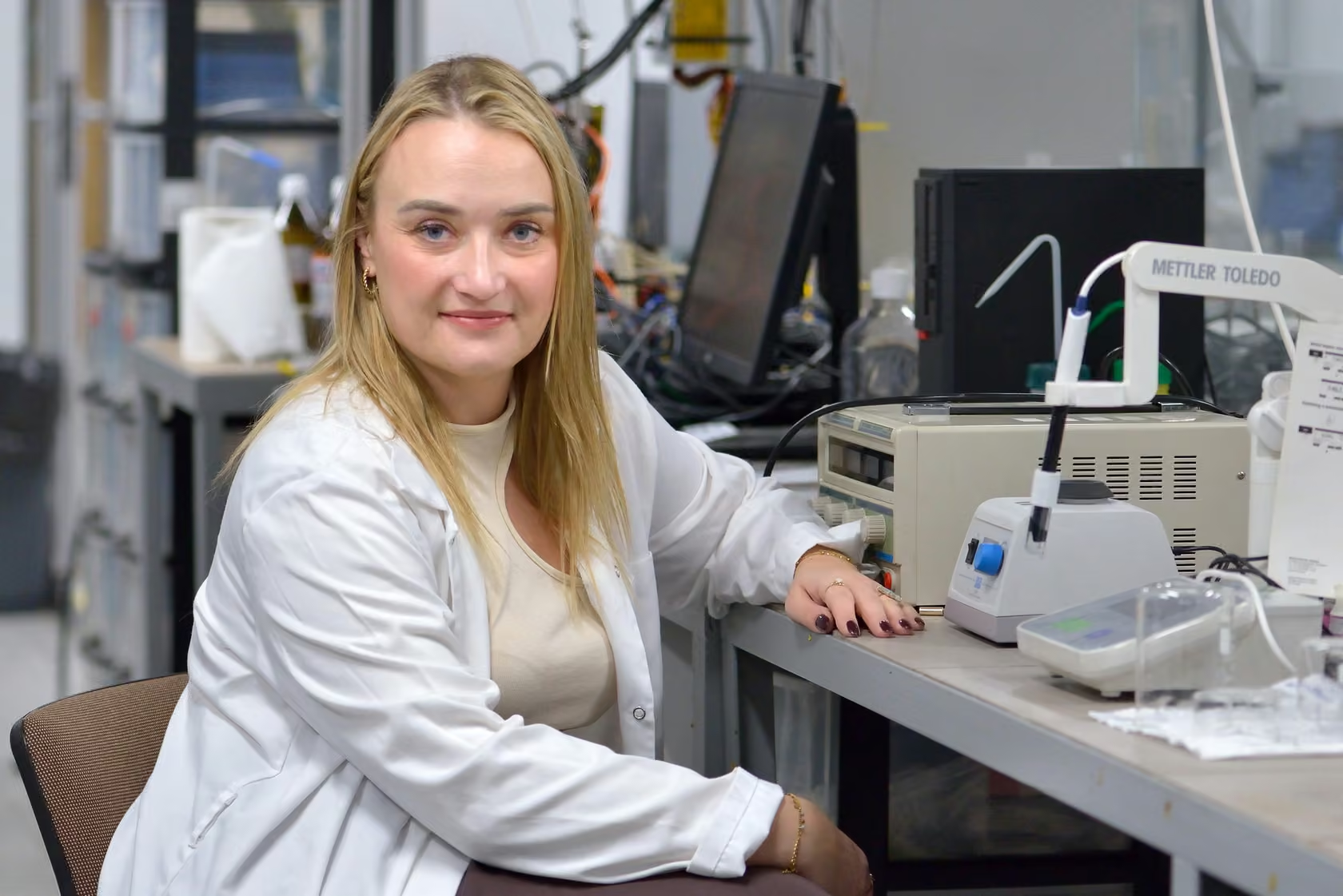
How can electrodes be designed to interact more effectively with delicate brain tissue? Dr Karolina Cysewska from Gdańsk University of Technology will seek to answer this question through her NEURO-FIT project, which has received PLN 4 million in funding from the Foundation for Polish Science. The grant will also enable her to establish her own laboratory at the Faculty of Electronics, Telecommunications and Informatics.
How can electrodes be designed to interact more effectively with delicate brain tissue? Dr Karolina Cysewska from Gdańsk University of Technology will seek to answer this question through her NEURO-FIT project, which has received PLN 4 million in funding from the Foundation for Polish Science. The grant will also enable her to establish her own laboratory at the Faculty of Electronics, Telecommunications and Informatics.
NEURO-FIT is one of 13 projects selected for funding in this year's FIRST TEAM FENG competition. Dr Karolina Cysewska received the maximum grant available under the call. Her project is the only one from Gdańsk to receive funding in this edition of the competition and the first at Gdańsk University of Technology to be supported through the FIRST TEAM FENG programme.
Electrodes That Adapt to Brain Tissue
Connecting electronics with living brain tissue presents a significant challenge for researchers. Electrodes used to record neural signals and stimulate neurons must not only conduct electrical impulses effectively but also interact safely with the delicate biological environment.
Dr Karolina Cysewska's team aims to develop bioadaptive microelectrodes that can better conform to brain tissue. The researchers will use conductive PEDOT hydrogels to create electrically active contact sites between the electrodes and the tissue.
To build three-dimensional structures, the team will employ multimaterial 3D bioprinting, which allows different materials to be combined. They will also investigate how nerve cells can integrate with conductive hydrogels. Their goal is to create a soft interface that interacts more effectively with brain tissue, enabling the recording of neural signals and stimulation of deep brain structures.
"I have been working on this concept for three years. During that time, I have developed a new approach to connecting electronics with brain tissue. This funding will finally allow me to test these ideas in practice and expand research that, until now, has largely remained a concept I developed myself," says Dr Karolina Cysewska.
A New Laboratory and International Collaboration
One of the most significant outcomes of the grant will be the official opening of the Bioelectronic Materials and Interfaces Lab at the Faculty of Electronics, Telecommunications and Informatics. Developed by Dr Karolina Cysewska as part of CysewskaLab, the laboratory will focus on bioelectronic materials and their applications in technologies that connect electronics with living tissues.
The researcher will establish her own team, working alongside scientists from international research institutions. The project's partners include Tim Harris from Johns Hopkins University, co-developer of Neuropixels probes, who will contribute his expertise in neural probe development. Michele Giugliano from the University of Modena and Reggio Emilia and Malavika Nair from the University of Oxford will bring their experience in electrophysiology and neuronal biology.
The research will also involve Dr Maciej Jankowski from DeepBrainLab at Gdańsk University of Technology, who specialises in electrode design and the study of neuronal activity, and Maciej Gołaszewski from BioCloner Health, who will support the work on bioprinting technology.
"Receiving this grant means much more to me than the opportunity to carry out a single project. It allows me to officially open my own laboratory at Gdańsk University of Technology and build a team with which I can conduct research into bioelectronic materials. This is an important milestone in my scientific career and an opportunity to collaborate with leading research institutions around the world," emphasises Dr Karolina Cysewska.
The NEURO-FIT project, officially titled "Bioadaptive Microelectrodes with In Vivo-Activated Hydrogel Contacts for Personalised Stimulation and Recording of Deep Brain Structures", has received funding under the Foundation for Polish Science's FIRST TEAM FENG programme, financed through the European Funds for a Modern Economy 2021–2027.