
Economic Convention at Gdańsk Tech. New forms of cooperation between business and science.
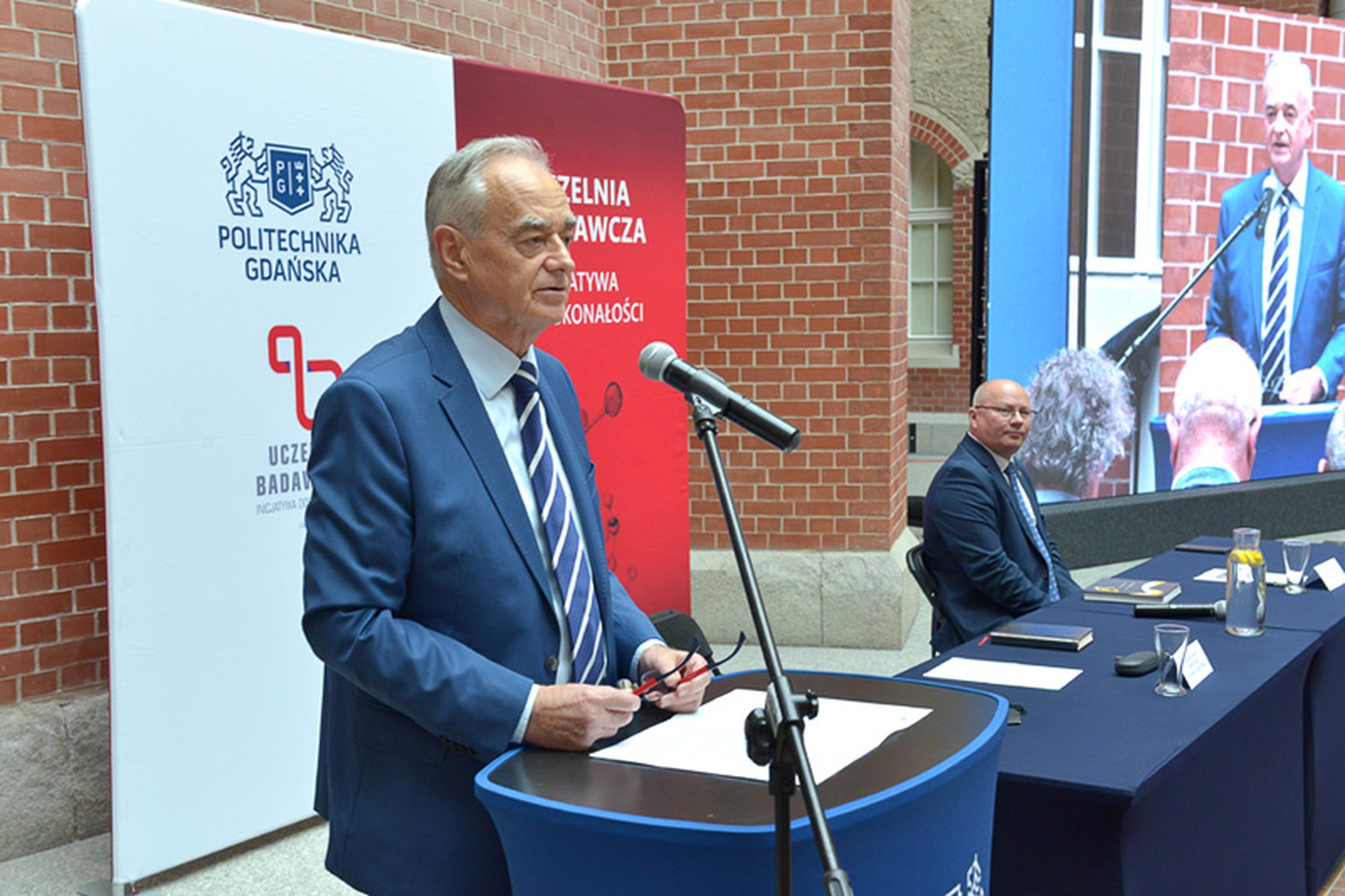
On September 16, 2021, the second meeting of the Economic Council at the Rector of Gdańsk Tech took place. After a long break caused by the pandemic, representatives of business and science met to discuss joint ventures and economic-scientific initiatives.
On September 16, 2021, the second meeting of the Economic Council at the Rector of Gdańsk Tech took place. After a long break caused by the pandemic, representatives of business and science met to discuss joint ventures and economic-scientific initiatives.
The Economic Council at the Rector of Gdańsk Tech serves as a platform for exchanging information, consultations, and expressing opinions and positions between the scientific community of Gdańsk Tech and the economic environment on all matters affecting the economic development of the country and the region, including the prospective needs of employers and the labor market, cooperation between the university and state and local government authorities, as well as other entities.
“One of our fundamental activities as a university is cooperation with the socio-economic environment,” said Prof. Krzysztof Wilde, Rector of Gdańsk Tech, opening the Council. “This business-science relationship, where scientific thought generated here transforms into concrete products, requires our joint actions. We have much to do in this regard to meet the standards of the US or Western Europe. The intensity of cooperation between entrepreneurs and scientists is important, but also developing a specific structure and defining new ways of joint activity. To find this common path, all members of this Council are indispensable. We must eliminate existing barriers, including communication ones, and build a well-functioning system.”
“The pandemic abruptly interrupted the implementation of assumptions developed during the first meeting of the Council,” said PhD Zbigniew Canowiecki, Chairperson of the Council. “Therefore, today, resuming its activities, we use the break between pandemic waves to meet in person in such a setting for—hopefully—fruitful deliberations and discussions.”
The September meeting began with a presentation of the research capabilities of four scientific centers and two research and implementation centers operating at Gdańsk Tech. Coordinators of the individual scientific centers: Prof. Jerzy Wtorek (BioTechMed), Prof. Jan Wajs (EkoTech), Prof. Łukasz Kulas (Digital Technologies Center), and Prof. Piotr Jasiński (Materials of the Future Center) discussed both research projects and staffing potential, as well as areas of possible collaboration with entrepreneurs. Meanwhile, Prof. Zbigniew Korczewski summarized three months of activity of the newly established Wind Technology Center, and Prof. Kazimierz Darowicki, as coordinator, presented the Hydrogen Technologies Center.
The next topic was a presentation of the achievements of the Doctoral School operating at Gdańsk Tech, presented by its head, Prof. Michał Mrozowski. The professor emphasized the multidisciplinary nature of doctoral education: “Few universities in Poland have the right to train doctoral students as broadly as Gdańsk Tech does, and all courses are conducted exclusively in English. Our ambition is for graduates of the Doctoral School to be individuals with versatile competencies, able to work in project-based systems and multinational environments.”
Prof. Kazimierz Darowicki spoke to the audience about implementation doctorates and the new model of university-business cooperation.
“The Implementation Doctoral School at Gdańsk Tech is the only such unit in Poland. It gathers the most experienced representatives of leading scientific disciplines. It allows doctoral students to receive training aligned with company needs but also fosters broad cooperation in international research teams,” emphasized Prof. Darowicki.
The second part of the Council meeting was dedicated to employers. The first speaker was the founder of the cosmetics company Ziaja Ltd., Zenon Ziaja, followed by Andrzej Synowiecki, president of Radmor S.A. The presenters shared not only the success their companies have achieved in domestic and foreign markets but also indicated challenges they face and expectations of scientific staff who, through commissioned research, could support technological processes in their firms.
The presentations of scientific centers, doctoral schools, and companies concluded with a discussion aiming to define common needs and expectations from entrepreneurs and scientific staff. The main conclusion was the need for clear and comprehensible communication and significantly more frequent contacts, for example in the form of seminars dedicated to enterprises. During such working meetings arranged in smaller groups, university staff will have a chance to present specific research that could be of interest to business, while entrepreneurs will discuss their R&D needs.
In the final part of the meeting, Council members listened to a presentation on building the academic community of Gdańsk Tech, delivered by Jan Mioduski, President of the Management Board of “Techno-Service” S.A., and information from Janusz Rybicki regarding the upcoming celebrations of the 100th anniversary of academic sports in Gdańsk.
The next Council meeting is planned for the first quarter of 2022.
Let us recall – during the previous term of Gdańsk Tech authorities (since 2016), the platform for cooperation and exchange of views between the university and the economic environment was the activity of the Gdańsk Tech Council, an advisory body to the rector, established based on the Act of 27 July 2005 “Law on Higher Education”. The Council undertook initiatives related to the development of the Lower Vistula and the post-shipyard areas in Gdańsk, known as the Young City, with the participation of representatives of state administration and local government authorities.
The Council, which operated until 2018 (the new Act “Law on Higher Education and Science” of 20 July 2018 established a body with different competencies – the University Council), actively participated in building mutual relations between the university and its environment and in the development of Gdańsk Tech’s activities for the economy and the Pomeranian community. That is why many people from the economic environment approached the rector of Gdańsk Tech with proposals to continue the work under a different legal framework. On 15 January 2020, the Senate of Gdańsk Tech positively endorsed the establishment of the Economic Council at the Rector of Gdańsk Tech.